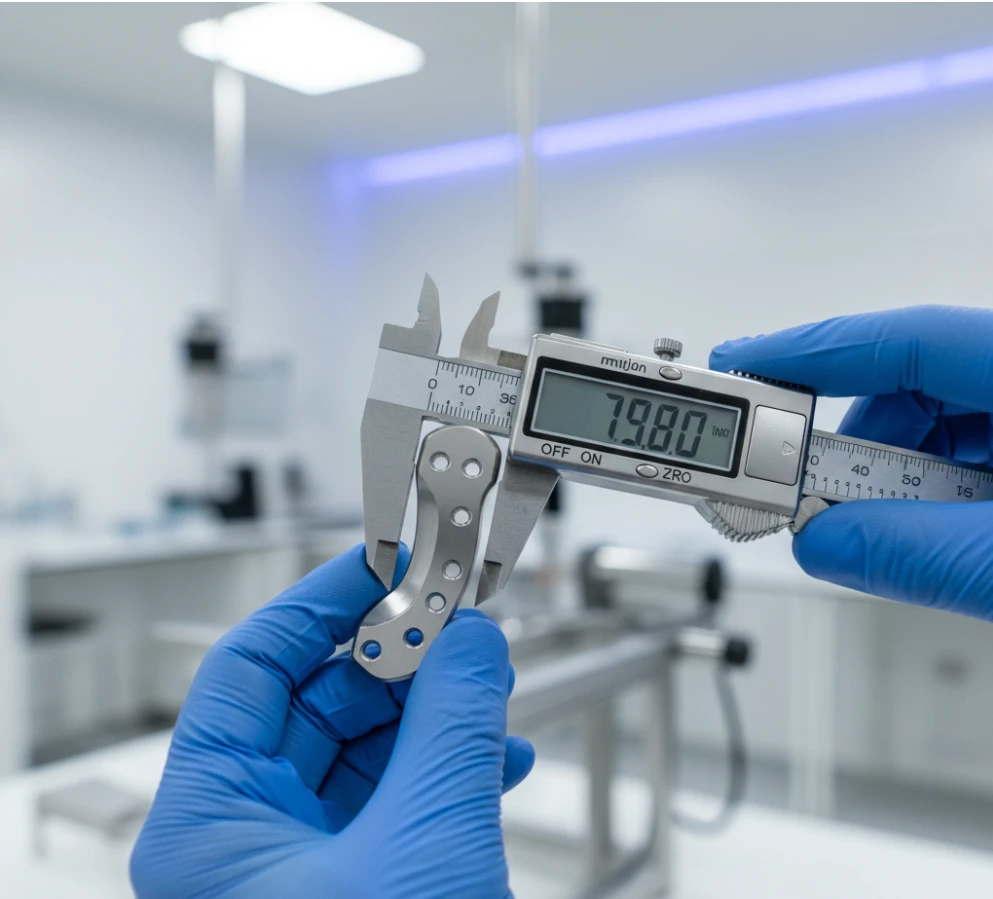
Let’s be real for a second. Sourcing medical devices—especially trauma implants—is a nightmare if you don’t know exactly what you’re looking at.
I’ve been in the game long enough to see the horror stories. A distributor in Brazil orders 500 plates, they arrive, and the locking screws don’t actually “lock” because the thread pitch is off by a fraction of a millimeter. Or worse, the surface anodization looks like it was done in a bathtub.
If you are a procurement manager, your neck is on the line. You aren’t just buying widgets; you’re buying parts that go inside human bodies. If those parts fail, it’s not just a refund request; it’s a lawsuit.
So, let’s cut the corporate fluff. You don’t need another generic article telling you “quality is key.” You need a battle-tested checklist to filter out the junk factories from the real orthopedic implant manufacturer partners.
Here is my personal QC checklist for sourcing trauma plates without getting burned.
1. The “Paperwork” Trap: Verifying Certificates
Everyone has a PDF. If I had a dollar for every photoshopped ISO certificate I’ve seen in my inbox, I’d be retired on a beach somewhere.
When a supplier sends you their certs, do not just file them away. You need to play detective.
ISO 13485: The Bare Minimum
If they don’t have ISO 13485 certified implants, close the tab. Walk away. This is the standard for medical device quality management systems. But here is the trick: look at the Scope of the certificate.
Does it actually say “Design and Manufacture of Orthopedic Implants”? I’ve seen suppliers pass off a certificate that only covers “Sales and Distribution” while claiming they are the factory. If they are just a middleman, you have zero control over QC.
How to verify:
Take the certificate number and go to the registrar’s website (like TUV, SGS, or BSI). If the database says “Invalid” or “Suspended,” you know they are lying to you.
The CE Mark and FDA Clearance
For CE marked trauma plates, check the “Notified Body” number (the 4 digits next to the CE symbol). If they claim CE certification but can’t show you the Declaration of Conformity linked to that specific product family (e.g., Upper Extremity Fixation), it’s a red flag.
FDA approved humerus plates are harder to fake because the FDA database is public and brutal. Ask for their 510(k) number. Search it. Does the manufacturer name match the factory name? If not, they are likely OEMing for someone else, which isn’t bad, but you need to know who is actually making the metal.
2. Material Science: It’s Not Just “Titanium”
I once had a supplier tell me, “Yes, it is Titanium,” and it turned out to be a commercial grade alloy that wasn’t biocompatible.
You need to demand the Material Test Report (MTR) for the specific batch of raw material used. You are looking for:
- Ti-6Al-4V ELI (Extra Low Interstitial): This is the gold standard (ASTM F136). The “ELI” part matters—it means fewer impurities like oxygen and iron, which improves ductility and fracture toughness.
- Stainless Steel (316LVM): If you are buying steel, it must be Vacuum Melted (VM). Regular 316L isn’t clean enough for permanent implantation.
Pro Tip: If the price is too good to be true, they are probably using Grade 2 Titanium (commercially pure) instead of Alloy, or they are using recycled scrap metal. Recycled titanium has fatigue issues. Don’t risk it.
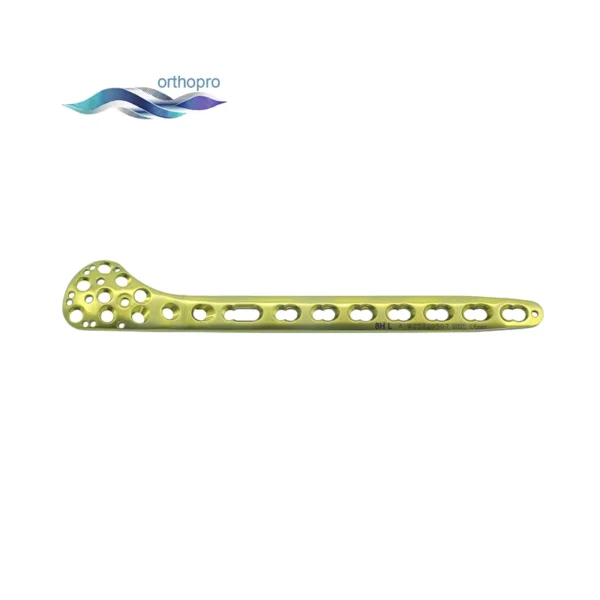
Proximal Humeral Locking Plate III – Titanium Shoulder Fracture Fixation System | Orthopedic Trauma Implants
The OrthoPro Proximal Humeral Locking Plate III is expertly engineered for the internal fixation of complex fractures of the humeral head. Featuring a low-profile anatomical design, this proximal humeral locking plate offers superior stability in osteoporotic bone through multi-planar screw
3. The “Screw Test”: Functional Quality Control
This is where the rubber meets the road. Or where the screw meets the plate.
In my experience, the number one failure point in medical device quality control isn’t the plate snapping; it’s the interface between the screw and the plate.
Cold Welding (Galling)
Titanium likes to stick to Titanium. If the manufacturer hasn’t perfected their surface treatment, the locking screw will “cold weld” to the plate hole before it’s even fully seated. The surgeon tries to remove it, the head strips, and now they have to drill it out in the OR. The surgeon will scream at the rep, the rep will scream at you.
Tolerance Testing
When we validate our products at OrthoPro, like our Proximal Humeral Locking Plate III, we run a “Go/No-Go” gauge test on every single locking hole.
Ask your supplier: “What is your tolerance range for the locking threads?”
If they say “standard” or don’t give you a number (like +/- 0.05mm), they aren’t measuring it.
| Feature | The Cheap Factory | The Quality Partner (e.g., OrthoPro) |
| Deburring | Sharp edges left in screw holes (cuts gloves) | Tumbled and hand-checked under microscope |
| Anodization | Uneven color, blotchy (Type II) | Uniform Type II anodization (anti-galling) |
| Locking Mech | Screws cross-thread easily | Self-tapping flutes engage smoothly |
| Marking | Laser marking fades after sterilization | Deep laser etching, traceable batch codes |
4. Visual Inspection: The “Naked Eye” Test
You don’t always need a scanning electron microscope to spot a dud. When you get samples (and always get samples), look for these dead giveaways:
- Burrs and Flash: Run your gloved finger along the edges of the plate. Is it smooth like glass, or does it catch? Micro-burrs can break off into the patient’s soft tissue, causing inflammation.
- Surface Consistency: Hold the plate under a bright light. Is the matte finish consistent? Shiny spots indicate poor sandblasting or inconsistent electropolishing.
- The “Suture Hole” smoothness: Specifically for shoulder implants like the Proximal Humeral Locking Plate III, surgeons need to pass needles through the suture holes. If those holes have sharp edges, they will cut the suture. That is a critical failure.
Unpopular Opinion: I actually prefer suppliers who admit when they have a bad batch. Manufacturing isn’t perfect. If a supplier tells me, “We delayed shipment by 3 days because Batch X failed the hardness test and we scrapped it,” I trust them more than the guy who claims 100% perfection every time.
5. Fatigue Strength: Will it Break?
Bones take a long time to heal. The implant has to bear the load for months.
You need to ask for their Fatigue Testing Reports (usually based on ISO 9585 or ASTM F382). They should be able to show you a curve (The Wöhler curve) that proves the plate can withstand usually 1 million cycles of load without bending or cracking.
If they say, “We used computer simulation (FEA),” that’s nice, but it’s not enough. Physical bench testing is the only way to be sure.
Case Study: The “Cheaper” Option
(Names changed to protect the guilty)
A distributor I know in Southeast Asia switched suppliers to save $15 per plate. The new factory looked great on Alibaba. ISO certs looked legit.
Three months later, surgeons started reporting that the screw heads were stripping during insertion. It turned out the factory wasn’t hardening the screw heads properly. The distributor had to recall $200,000 worth of inventory. The $15 saving cost them their reputation and nearly bankrupt them.
The Lesson: Price is important, but consistency is survival.
6. Packaging and Sterility
Most trauma plates are sold non-sterile, but if you are buying sterile-packed goods, the stakes are higher.
Check the packaging seal. Is it a Tyvek pouch? Who does the sterilization? (Gamma or EtO). You need the validation report for the sterilization process.
Even for non-sterile plates, how do they arrive? Are they double-bagged? If they arrive in a cardboard box with metal banging against metal, the anodization will be scratched before it even gets to your warehouse.
At OrthoPro, we are obsessive about this. We assume the shipping box will be thrown off a truck, so the internal packaging has to be bombproof.
FAQ: Questions B2B Buyers Ask Us
Q1: Can I mix and match screws and plates from different manufacturers?
Technically, many systems are “AO compatible,” but I strongly advise against it. Small variations in thread pitch or head geometry can reduce the locking strength. It’s a liability risk. Stick to a system where the Orthopedic implant manufacturer guarantees the match.
Q2: What is the typical lead time for a custom OEM order?
If a factory tells you 2 weeks for a new design, they are lying. Proper tooling, prototypes, and mechanical testing take time. Realistically, expect 45-60 days for the first run of a new OEM product. For standard stock like our Proximal Humeral Locking Plate III, we usually ship much faster.
Q3: How do I handle a recall if I import from overseas?
You need a quality agreement in your contract. The supplier must have a traceable lot system (down to the raw material heat number) and a clear procedure to replace stock or reimburse costs if a manufacturing defect is found.
The Bottom Line
Sourcing isn’t about finding the cheapest metal; it’s about finding a partner who sleeps less so you can sleep more.
You need transparency. You need a supplier who sends you the raw material certs without you having to beg. You need products that surgeons enjoy using because the screws lock in satisfyingly tight every single time.
If you are currently struggling with inconsistent quality, or you just want a second opinion on your trauma supply chain, let’s talk. We’ve built our reputation on being the boring, reliable choice—no drama, just good implants.
Check out our Proximal Humeral Locking Plate III to see what proper engineering looks like.
Ready to upgrade your inventory?
Don’t guess with quality. Contact Us at OrthoPro today. Drop us an email at info@orthopro.mx and ask for our full QC documentation package. Let’s get your surgeons the tools they can trust.