Look, if you are sitting on the fence trying to figure out whether to launch your own brand of implants or just act as a distributor for an established manufacturer, you are not alone. Every ambitious B2B buyer in the medical device sector hits this crossroads eventually.
You look at the margins on raw manufacturing and think, “Why am I giving up 40% of my profits to the parent brand?” It seems like a no-brainer to just find a factory, slap your logo on a titanium screw, and start printing money.
But I’m going to be blunt with you. I’ve spent years in the trenches of the global implant trade, and I’ve watched alot of smart people blow millions of dollars because they let their ego dictate their business model. They wanted their name on the box without understanding the brutal reality of regulatory compliance, post-market surveillance, and cash flow death valleys.
So we are going to break this down without the corporate fluff. We’ll look at the gritty realities of OEM manufacturing, the safety nets of an orthopedic distributorship, and how to figure out which path will actually survive in your specific local market.
The Raw Truth About OEM Manufacturing in Orthopedics
Let’s start with the dream: OEM manufacturing. You find a high-quality factory, you commission a line of trauma plates or spinal pedicle screws, and you build a brand that you own 100%. This is the core of private label orthopedics.
The upside is massive. You control the pricing. You own the customer relationships completely. If a hospital loves your product, they are tied to you, not a foreign manufacturer who might decide to cut you out of the loop in five years and go direct-to-market.
But here is the stuff nobody tells you at trade shows.
When you become the legal manufacturer on paper (which is what happens in a true private label setup), you absorb 100% of the regulatory liability. Under the new European Medical Device Regulation (EU MDR), the cost to certify a Class IIb or Class III implant has skyrocketed. We are talking about hundreds of thousands of dollars and sometimes 18 to 24 months of waiting just to get the paperwork cleared.
Can your cash flow survive two years of zero revenue while regulatory bodies scrutinize your technical files?
The Formula for OEM Survival
If you are seriously considering the OEM route, you need to run this math before you ever sign an NDA with a factory. Forget gross margin; you need to look at your true break-even volume.
Break-Even Volume = Total Fixed Costs / (Unit Selling Price – Variable Landed Cost)
- Total Fixed Costs: This isn’t just warehouse rent. This includes your initial quality management system (QMS) setup, ISO 13485 certification, local regulatory registration fees (like FDA 510(k), CE mark, or COFEPRIS in Latin America), and the massive minimum order quantities (MOQs) the factory will demand.
- Variable Landed Cost: The factory price + shipping + import duties + insurance + the cost of capital tied up in inventory.
If your regional market demand doesn’t allow you to hit that Break-Even Volume within 12 to 18 months, private labeling will bleed your company dry.
The Case for a Solid Orthopedic Distributorship
Now let’s look at the other side of the coin. Acting as an exclusive or non-exclusive distributor for an established brand like OrthoPro.
Some ambitious entrepreneurs look down on the distributorship model. They think of it as “just middleman work.” That is a dangerous mindset. In many emerging and established markets, a strong orthopedic distributorship is actually the most lethal and profitable business model you can deploy.
Why? Speed to market.
When you partner with a manufacturer that already has deep clinical data, proven surgical techniques, and global certifications, you bypass the regulatory nightmare. Your only job is local registration (which is usually drastically faster when the parent company hands you a pristine Free Sale Certificate and technical dossier) and aggressive sales.
Let’s look at a real-world scenario
I won’t name names, but consider a mid-sized distributor in Southeast Asia we worked with a few years ago. They had a massive hospital network and decided they wanted to transition from distributing European brands to their own private label orthopedics line.
They sourced a factory in Asia. The prototypes looked great. But they vastly underestimated the local Ministry of Health’s new tightening on clinical evaluation reports (CERs) for OEM brands without a home-country track record. Their products sat in a bonded warehouse for 14 months accumulating fees. The sales team, having nothing to sell, started jumping ship to competitors.
They ended up scrapping the OEM project at a $400,000 loss. They pivoted back, signed a master distribution agreement with a reliable global manufacturer, and leveraged the manufacturer’s existing brand equity. They were back in the black within six months.
When you distribute, you are leveraging the manufacturer’s R&D budget. You don’t have to worry about updating the product line when a new minimally invasive technique hits the market; the manufacturer does that for you.
Why Medical Device Branding is a Double-Edged Sword
This brings us to the concept of medical device branding.
Creating a brand is incredibly seductive. But surgeons are historically conservative creatures. They do not like changing the tools they use to fix shattered bones. If a trauma surgeon is used to the tactile feedback of a specific locking screw, convincing them to switch to your unknown private label brand requires a monumental amount of trust.
Building that trust requires heavy marketing spend. You need to sponsor cadaver labs, fly key opinion leaders (KOLs) to conferences, and publish case studies. If you are an OEM, all those costs come out of your bottom line.
If you are part of an orthopedic distributorship network, a good manufacturer will co-op those marketing costs. They will supply the marketing collateral, the surgical technique guides, and sometimes even the demo instruments.
I’ll just say it: most local distributors have zero business trying to build a trauma line brand from scratch. They treat marketing like a part-time job for their sales reps, and then act suprised when hospital procurement committees reject their private label bids in favor of recognized global brands.
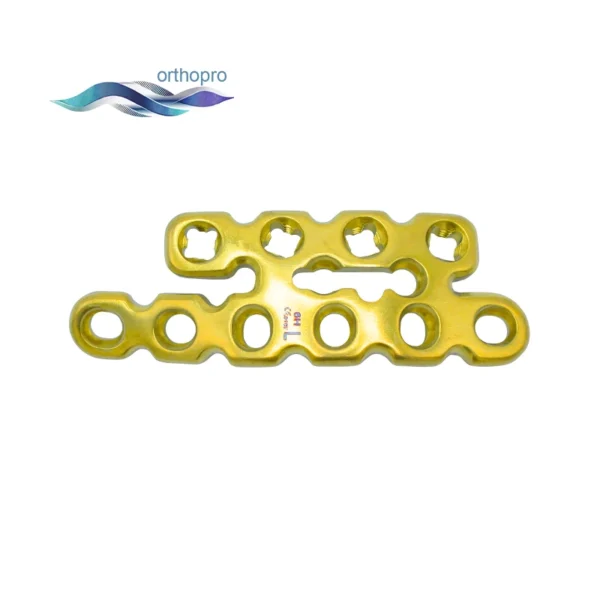
Posterior Pelvic Plate System – Titanium Locking Implant for Pelvic Ring Fracture Fixation
The Posterior Pelvic Plate by OrthoPro is engineered to provide rigid stabilization for complex posterior pelvic ring disruptions. Designed for high-energy trauma cases, this Posterior Pelvic Plate features a low-profile construction that minimizes soft tissue irritation while ensuring superior biomechanical strength. Our locking system offers optimal compression and fixation for sacral and iliac fractures.
High-Risk Implants: A Reality Check
Let’s get specific about the products themselves. The type of implants you sell definately dictates which business model you should choose.
If you are selling external fixators or standard cortical screws, the barrier to entry is lower. These are often treated almost like commodities in highly price-sensitive markets. A private label might work here if your volume is huge.
But what about complex, high-risk trauma products? Take something highly specialized like a Posterior Pelvic Plate.
Pelvic surgeries are high-stakes, bloody, and mechanically demanding. The plates have to be anatomically pre-contoured perfectly, and the locking mechanisms cannot fail. If you try to OEM a product like this, and there is a mechanical failure in the OR, your local brand takes 100% of the blast damage. The liability is terrifying.
When you act as a distributor for a product like the Posterior Pelvic Plate from a reputable manufacturer, you are shielded by their quality assurance, their batch testing, and their global clinical history. The surgeon feels safer, the hospital purchasing director feels safer, and frankly, you should feel safer.
Comparison: OEM vs Distributorship
Sometimes seeing it laid out is the only way to make the decision. Here is a raw breakdown of how these two models actually compare in the wild.
| Business Factor | Private Label OEM | Orthopedic Distributorship |
| Upfront Capital | Very High (Tooling, MOQs, QMS, Regs) | Low to Medium (Initial stock, local reg) |
| Time to First Sale | 12 to 24 months | 3 to 6 months |
| Gross Margin | Excellent (often 60-80%+) | Good (usually 30-50%) |
| Brand Equity | You own it completely | Belongs to the manufacturer |
| Regulatory Burden | You carry the entire weight | Manufacturer does the heavy lifting |
| Agility / Pivoting | Slow (stuck with factory contracts) | Fast (can add new product lines easily) |
When Does Private Label Orthopedics Actually Make Sense?
I’ve been tough on the OEM model, but I don’t hate it. It just has to be deployed in the right enviroment.
Private label orthopedics makes sense if you meet three specific criteria:
- You dominate a price-sensitive local market: If your region’s healthcare system is entirely driven by public tenders where the lowest bidder wins, brand loyalty means nothing. In this scenario, cutting out the manufacturer’s margin via an OEM model is the only way to win massive government contracts and stay profitable.
- You have a massive existing distribution network: You already have 50 reps on the ground and contracts with 200 hospitals. You can instantly push volume to meet the factory MOQs without sweating.
- Local regulations are favorable: Some regions still have somewhat relaxed importation and registration rules for medical devices, or they fast-track products that are manufactured locally. If you can legally assemble or package OEM parts in your country to get a “Made in [Your Country]” tax break, the math shifts heavily in your favor.
The Hybrid Approach: The Smart Money Move
Here is a secret that the biggest regional players use. You don’t actually have to choose just one. The most robust businesses run a hybrid model.
They will secure an orthopedic distributorship for highly complex, premium products. They will partner with an authoritative brand like OrthoPro to supply their top-tier trauma and recon lines. This gets them into the prestigious private hospitals and satisfies the top-tier surgeons who demand branded excellence.
At the same time, they will spin up a separate subsidiary to run a private label line of basic consumables—K-wires, basic drill bits, maybe standard non-locking plates. They use their high-margin, high-prestige distributorship to fund the slow, grinding growth of their OEM commodity line.
This hybrid approach diversifies your risk. If the local government suddenly slashes reimbursement rates for implants, your cheap OEM line captures the down-market shift. If the market demands higher quality, your branded distributorship line captures the premium revenue.
What the Market Data is Screaming at Us
You can’t make a strategic decision without looking at the macro data. According to industry reports from firms like Fortune Business Insights, the global orthopedic devices market is massive—valued at over USD 55 billion and projected to grow steadily. But the underlying trend is what matters.
The data shows a massive consolidation happening. Small, independent OEM brands are being crushed by regulatory costs, specifically in Europe and regions that mirror FDA/CE standards. Meanwhile, the specialized distributor network is expanding. Manufacturers realize they cannot navigate the localized politics of every country in LATAM, the Middle East, or Asia. They need strong regional distributors.
Manufacturers are offering better margins and more exclusivity to distributors than they did ten years ago because the cost of building a direct sales force in a foreign country is astronomical.
Right now, it is a distributor’s market. If you have the local hospital relationships, you hold the power. You can negotiate incredible terms with a manufacturer without taking on the crippling liability of OEM manufacturing.
Final Thoughts Before You Sign a Check
Choosing between building an OEM empire and dominating as an orthopedic distributor will define your company for the next decade.
If you have deep pockets, incredible patience, and a legal team ready to fight regulatory bodies for two years, private label might be your golden ticket.
But if your goal is aggressive growth, rapid cash flow turnaround, and selling high-quality, clinically proven implants without the sleepless nights worrying about technical dossiers, then partnering with an established brand is the undisputed winner.
Don’t let the allure of having your name on a box blind you to the reality of the balance sheet. Find a manufacturer that treats you like a partner, not just a customer, and build a fortress in your local market.
Frequently Asked Questions (FAQ)
1. Is it possible to transition from an orthopedic distributorship to an OEM model later?
Absolutely. Many successful companies start as distributors to build capital, establish hospital networks, and understand local surgeon preferences. Once they have consistent cash flow and market dominance, they slowly introduce their own private label products, usually starting with lower-risk Class I or Class IIa devices before moving into complex trauma implants.
2. How do manufacturers protect my territory if I become their distributor?
This comes down to your distribution agreement. You must negotiate a strict exclusivity clause for your specific region or country. A reputable manufacturer like OrthoPro will protect your territory, channel all local leads directly to your sales team, and refuse to sell to grey-market exporters who try to undercut your region. Always get the exclusivity terms clearly defined in writing before you commit resources to marketing their brand.
3. Will an OEM factory help me with the regulatory registration in my country?
Most contract manufacturers will provide you with the basic technical files, raw material certificates, and their own ISO 13485 certificates. However, they will rarely hold your hand through your local Ministry of Health registration. As the private label owner, the burden of translating documents, paying local regulatory consultants, and dealing with clinical evaluation gaps falls entirely on your shoulders. If you lack regulatory expertise, you should lean toward a distributorship model where the parent brand provides a complete, ready-to-file regulatory dossier.
Ready to Dominate Your Local Market? Make Your Move.
If you’ve read this far, you know that success in the orthopedic implant business isn’t about guessing; it’s about strategic partnerships. Whether you are tired of dealing with unreliable OEM factories or you are looking to elevate your product portfolio with world-class, fully certified trauma implants, you need a manufacturing partner that actually understands your daily grind.
At OrthoPro, we don’t just sell metal. We build long-term, high-profit distributorships with B2B partners across the globe. We provide the premium implants, the rigorous clinical backing, and the aggressive margins you need to outmaneuver your local competitors.
Stop bleeding cash on regulatory dead-ends and start selling.
Reach out to our global expansion team today to discuss exclusive distribution opportunities in your region.
Head over to our Contact Page to submit your company profile, or skip the forms and email us directly at info@orthopro.mx. Let’s build something highly profitable together.