Let’s be real for a second. Running a large medical device distribution network isn’t for the faint of heart. You’re dealing with demanding hospital procurement directors, surgeons who complain if a drill is 50 grams too heavy, and a supply chain that feels like it’s constantly hanging by a thread.
When you’re out there looking for a reliable orthopedic equipment manufacturer, the stakes couldn’t possibly be higher. We aren’t talking about sourcing cheap plastic phone cases. We’re dealing with Class II and Class III medical devices. If a drill motor stalls halfway through a femur fracture repair, your company’s reputation is entirely fried.
The market is massive, by the way. Recent data from Grand View Research showed the global orthopedic power tools market hit around $1.71 billion in 2023, and it’s projected to climb to over $2.21 billion by 2030. Everyone wants a piece of that pie. But to actually make decent margins and win those multi-year hospital tenders, your backend supply chain has to be bulletproof.
Grab a coffee, because we’re going to break down exactly what you need to look for when evaluating global suppliers, the hidden traps of sourcing overseas, and why getting your own custom branded tools is the only way to survive in this cutthroat market.
The Harsh Reality of Sourcing Surgical Drills from China (and Beyond)
Alright, time for a controversial opinion that might step on some toes. If you’ve spent any time sourcing surgical drills from China, Mexico, or anywhere else, you already know it’s an absolute minefield.
ALOT of the so-called “manufacturers” you talk to on B2B platforms are just trading companies. They sit in a nice office building, act as middlemen, and take a 30% cut while farming your order out to three different sub-par workshops. This is exactly why your first sample unit looks like a masterpiece, but your third bulk order arrives with rusted drill chucks and batteries that die after five minutes.
You need a direct line to the actual factory floor. Period.
When you partner with a legitimate facility—like OrthoPro over in Mexico—you’re dealing with the people who actually calibrate the CNC machines. If you skip the factory audit just to save a few bucks on a flight, you’re basically gambling with your entire business.
You want to see the raw titanium and medical-grade stainless steel coming in the back door, and the finished, calibrated drills going out the front. If a supplier refuses a video tour of their assembly line, run the other way.
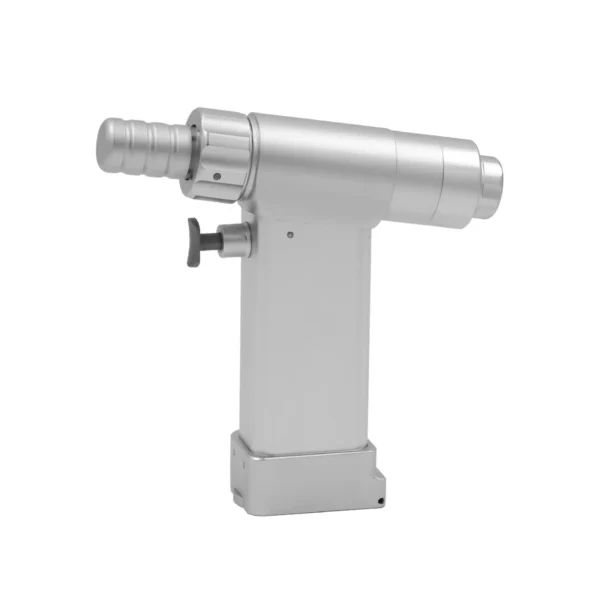
Mini Multi-functional Orthopedic Drill for Small Bone Surgery | Hand, Foot, and Podiatry Surgical Power Tool System – OrthoPro
The OrthoPro Mini Multi-functional Drill is a versatile orthopedic power tool specifically engineered for high-precision hand, foot, and podiatry surgeries. This mini multi-functional drill features a modular design, allowing surgeons to switch between drilling, sawing, and K-wire fixation seamlessly. As a leading multi-functional bone drill, it offers exceptional torque and ergonomic control for delicate small bone procedures.
ISO Certified Surgical Tools: Looking Past the Fancy PDF
Every single supplier in the world will slap an “ISO 13485” badge on their website. Honestly, I’ve seen enough photoshopped CE and ISO certificates to last a lifetime. A shiny PDF attached to an email means absolutely nothing if the factory floor is a chaotic mess.
So, how do you verify if they actually produce ISO certified surgical tools? You look at their traceability and their Quality Management System (QMS).
Imagine a scenario: A hospital in Germany reports that a battery pack melted inside their autoclave. A real factory doesn’t just apologize and send a new one. They take the serial number of that drill, pull up their database, and trace it back to the exact day it was assembled, the specific technician who soldered the battery connections, and the exact batch of raw materials used.
When you audit a potential partner, ask them these specific questions:
- What is your runout tolerance on a standard bone drill bit? (If they don’t instantly say something like +/- 0.05mm, they don’t know what they are doing).
- Can your handpieces genuinely survive 135°C high-pressure steam sterilization without the internal seals degrading?
- Do you use sealed brushless motors, or cheap brushed motors that will create carbon dust inside the sterile housing?
Capacity Stability is King: The Math Behind the Madness
As a large distributor, your worst nightmare isn’t a slightly higher unit price. Your worst nightmare is a stockout. If you win a massive regional government tender for 300 surgical saw systems and your factory suddenly emails you saying, “Sorry, we are delayed by 4 months,” you are dead in the water.
Capacity stability is everything. But factories lie about their capacity all the time. They’ll tell you they can produce 10,000 units a month, but a quick look at their equipment tells a different story.
Here is a quick formula I use to calculate a supplier’s true capacity during an audit:
True Monthly Capacity = (Total CNC Machines * Operating Hours per Month) * Yield Rate
If they only have four 5-axis CNC machines running single shifts, and an 85% yield rate (meaning 15% of their parts fail QC and have to be scrapped), the math simply doesn’t support their promise of 10,000 units. You need a partner who has scalable infrastructure.
The Good vs. The Bad: A Quick Comparison
To make this easier to digest, here is a breakdown of what a reliable factory looks like compared to a risky middleman.
| Metric | The Middleman / Fake Factory | The Real Orthopedic Equipment Manufacturer |
| R&D Capability | None. They just copy existing designs. | In-house engineering team, solid CAD software, rapid prototyping. |
| Material Traceability | Non-existent. “Trust us, it’s stainless steel.” | Full lot tracking. Mill certificates provided for every batch of 316L or Titanium. |
| Autoclave Testing | Tests one unit, assumes the rest are fine. | Rigorous aging and moisture ingress testing on every production batch. |
| After-Sales Support | Ignores emails after the container ships. | Provides spare parts, repair manuals, and technical video support. |
Why Medical Device OEM/ODM is Your Secret Weapon
Let’s talk strategy. The globalmedical device OEM/ODM (Original Equipment Manufacturer / Original Design Manufacturer) market was valued at an insane $115.4 billion in 2024, and it’s projected to reach nearly $191.7 billion by 2031.
Why is it growing so incredibly fast? Because smart distributors realize that if they just resell another factory’s brand, they are completely replaceable. A hospital procurement manager can easily bypass you and go straight to the source, or find another distributor selling the exact same brand for 5% less.
To protect your profit margins and build real equity, you need your own brand.
OEM vs. ODM: What’s the difference?
- OEM: You hand the factory your own blueprints and CAD files. They build it exactly to your specs. It’s your intellectual property.
- ODM: You go to the factory and say, “I need a lightweight cannulated drill for hand surgery, but I want it to have a 2-hour battery life and an ergonomic grip that fits European surgeons better.” The factory designs it, tests it, and puts your logo on it.
By utilizing ODM services, you create a moat around your business. You control the pricing, you control the branding, and the hospitals become loyal to your specific product, not the factory’s. But you can only do this if you partner with a manufacturer that actually has an R&D department. If they can’t customize a Jacobs chuck or tweak a quick-coupling mechanism for you, they aren’t a real ODM partner.
A Distributor’s Nightmare (And How They Fixed It)
Let me share a quick story. I won’t name the company to protect their privacy, but it’s a large orthopedic distributor based out of the UK.
A few years ago, they were buying off-the-shelf surgical drills from a random trader they found online. The price was dirt cheap. But soon, the complaints started rolling in. The battery connectors were melting during the hospital’s standard autoclave cycles. Surgeons were furious because the drills were stalling while inserting pedicle screws during spinal fusions.
They were bleeding cash on warranty replacements. The true cost of a bad product isn’t just the unit cost. Here is the reality check formula:
Warranty Bleed = (Total Units Sold * Defect Rate) * (Cost of Replacement + Shipping + Wasted Admin Time + Lost Future Contracts)
They finally woke up, ditched the trader, and partnered directly with a certified facility capable of true medical device OEM/ODM. They spent three months co-developing a completely sealed battery pack and upgraded the internals to high-torque brushless motors.
Sure, their upfront unit cost increased by about 12%. But their defect rate plummeted from a disastrous 9% down to 0.4%. Their profit margins skyrocketed because they stopped giving away free replacements, and surgeons actually started requesting their brand by name.
Drilling Down: Finding the Right Tools for the Job
Not all surgeries require a massive, heavy-duty drill. In fact, the trend in orthopedics right now is shifting heavily toward minimally invasive procedures. Surgeons doing foot and ankle reconstructions, hand surgeries, or even specialized veterinary orthopedics need tools that are incredibly precise and lightweight.
If you are sourcing for these specific departments, you need to look at specialized equipment like the Mini Multi-functional Orthopedic Drill.
When evaluating a mini drill from a factory, don’t just ask about the price. Ask about the specs that actually matter to the end-user:
- Cannulated Design: Can it easily accommodate K-wires? A solid shaft is useless for a lot of trauma fixations.
- Stepless Speed Control: The trigger needs to be highly responsive. A surgeon doesn’t want an “on/off” switch; they need to feather the speed perfectly when dealing with fragile small bones.
- Vibration Dampening: If the drill rattles like a cheap lawnmower, the surgeon’s hand is going to fatigue, and their precision will drop. You want a tool with a meticulously balanced motor.
- Sterilization Compatibility: It has to survive standard steam sterilization (135°C, 1.6 MPa) repeatedly without the internal lubricants breaking down.
OrthoPro excels in this specific area because they understand the clinical application of the tools, not just the metal machining process. They know that a drill isn’t just a piece of metal—it’s an extension of the surgeon’s hand.
Building a Long-Term Supply Chain
Switching suppliers is expensive. Registering a new medical device with your local health authority (whether it’s the FDA, CE, or your national equivalent) takes months and costs a small fortune in regulatory fees. You do not want to be hopping from one factory to another every two years.
You need to find a partner who is financially stable, communicates clearly, and understands the regulatory landscape of your target market. When you talk to their sales reps, they shouldn’t just be order-takers. They should be able to intelligently discuss the differences between Ni-MH and Lithium-ion medical batteries, or explain why AO quick couplings are preferred in certain regions.
It’s a tough market out there, but if you secure the backend of your business with a world-class orthopedic equipment manufacturer, the front-end sales become a whole lot easier. You stop selling on price and start selling on reliability.
Frequently Asked Questions (FAQ)
Q1: How can I verify if an orthopedic equipment manufacturer’s ISO certificate is actually real?
Don’t just trust the PDF. Look at the certification body that issued it (e.g., SGS, TUV, BSI). You can usually go to the issuing body’s official website and type in the certificate number to verify if it is currently active. Also, ask the factory for their most recent audit report, not just the certificate.
Q2: What is the typical MOQ (Minimum Order Quantity) for a custom medical device OEM/ODM project?
It realy depends on the factory and the complexity of the customization. If you just want your logo laser-etched onto an existing drill design, the MOQ might be as low as 10 to 20 units. However, if you need a custom-tooled housing or a completely unique battery configuration, expect an MOQ of 100+ units to cover the factory’s R&D and tooling costs.
Q3: Are brushless motors really that much better when sourcing surgical drills?
Absolutely. Brushed motors use carbon brushes that wear down over time, creating internal dust and generating excess heat. Brushless motors are far more efficient, run cooler, produce significantly less noise, and have a much longer lifespan. They cost a bit more upfront, but they drastically reduce your warranty return rates.
Ready to Upgrade Your Surgical Power Tool Supply Chain?
- Attention: Are you exhausted from dealing with unpredictable trading companies, delayed shipments, and surgeons complaining about faulty equipment?
- Interest: Imagine partnering directly with a factory that delivers premium, ISO certified surgical tools on time, every time, tailored specifically to your brand’s requirements.
- Desire: You can finally secure those massive hospital procurement contracts with absolute confidence, knowing your products won’t fail in the operating room. Increase your margins, lower your defect rates, and own your market.
- Action: Stop settling for sub-par suppliers. Head over to our Contact Us page right now, shoot an email directly to info@orthopro.mx, and let’s discuss how we can build a rock-solid OEM/ODM partnership that scales your business.