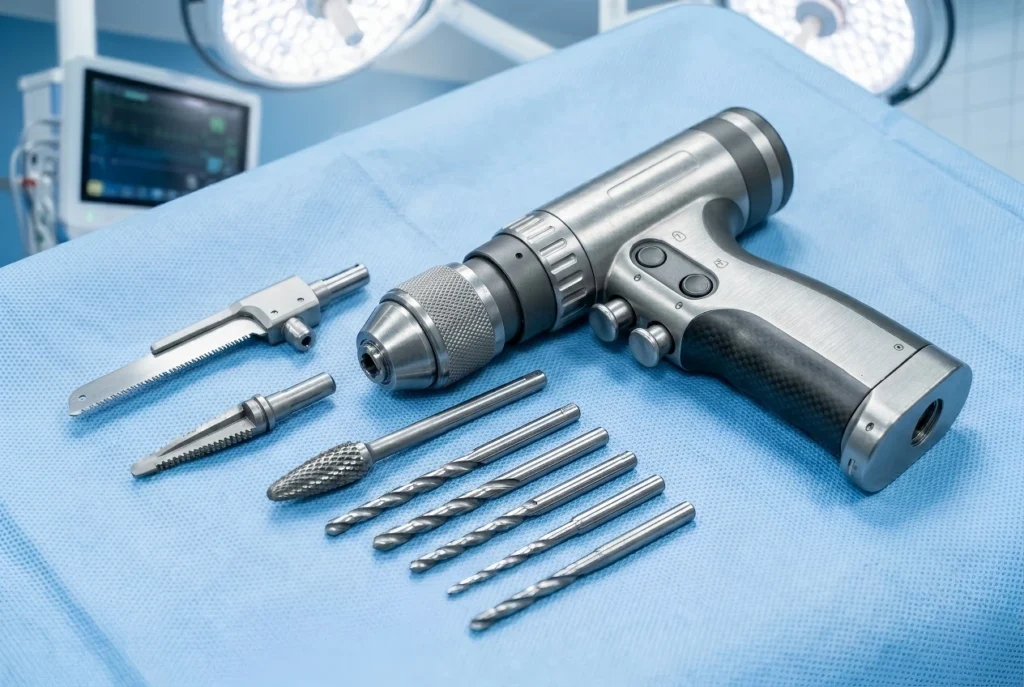
Look, I’ve spent the better part of a decade walking into hospital procurement offices, sterile processing departments (SPDs), and operating rooms. Want to know a dirty little secret in the medical device world? Half the tools sitting in those massive, expensive, pre-packaged surgical sets never actually touch a patient.
They get unpacked, sterilized, placed on the back table by the scrub tech, ignored by the surgeon, and sent right back to SPD to be washed again. It’s an absolute drain on hospital budgets and sterile processing bandwidth.
I’m just going to say it: buying massive “one-size-fits-all” trauma or small bone kits from legacy brands is usually a waste of money. You are paying for fillers. Instead of buying a rigid setup that actually fits nobody perfectly, smart clinics and B2B distributors are shifting heavily toward customizable surgical kits. And the absolute beating heart of these custom setups? A reliable multi-head bone drill.
Why carry a dedicated standalone drill, a seperate K-wire driver, and a dedicated micro-saw when a single lightweight handpiece can do all three just by snapping on a different head? It just makes more sense from an economic and clinical standpoint.
Let’s break down how to actually build a functional, customized kit around a mini orthopedic drill, what attachments you actually need, and the math behind why certain tools perform better.
The Core: Why the Mini Multi-Functional Orthopedic Drill is Taking Over
When you are dealing with hands, feet, maxillofacial trauma, or veterinary orthopedics, a heavy battery-powered drill designed for total hip arthroplasty is going to be a nightmare to use. Surgeons complain about wrist fatigue, and frankly, heavy tools cause accidental soft tissue damage when you’re working in tight spaces like a carpal tunnel release or a complex bunionectomy.
You need something lightweight. But “mini” shouldn’t mean weak.
If you look at the OrthoPro lineup, specifically theirmini multi-functional orthopedic drill, you see the exact architecture that modern clinics are looking for. It’s a single powered handpiece (usually a high-performance brushless motor) that accepts various quick-connect attachments.
From a B2B procurement side, this is gold. You buy the base handpieces in bulk, and then you consult with your specific hospital departments to buy only the attachment heads they actually use.
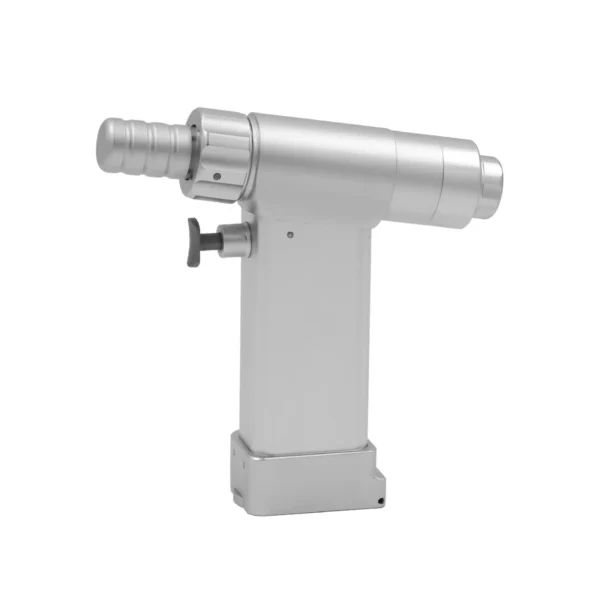
Mini Multi-functional Orthopedic Drill for Small Bone Surgery | Hand, Foot, and Podiatry Surgical Power Tool System – OrthoPro
The OrthoPro Mini Multi-functional Drill is a versatile orthopedic power tool specifically engineered for high-precision hand, foot, and podiatry surgeries. This mini multi-functional drill features a modular design, allowing surgeons to switch between drilling, sawing, and K-wire fixation seamlessly. As a leading multi-functional bone drill, it offers exceptional torque and ergonomic control for delicate small bone procedures.
Choosing the Right Orthopedic Drill Bits and Chucks
The most basic attachment you’ll buy is the drill chuck. But even here, people make mistakes. You generally have two choices for your customizable surgical kits: a keyed Jacobs chuck or a keyless AO quick-coupling.
The Keyless AO Quick Coupling
If your surgeons are using standard AO-shank orthopedic drill bits, this is a must-have. It allows for one-handed insertion and removal of bits. When you are fixing a distal radius fracture and the surgeon needs to drill a hole, swap to a tap, and then drive a screw, they cannot be messing around with a chuck key. It takes to much time.
The Jacobs Chuck
Sometimes you just need to grab a smooth shank bit or an off-brand pin. A small Jacobs chuck attachment gives you universal compatibility. Yes, you need the little key, and yes, it’s annoying when the scrub tech drops it off the sterile field, but the versatility is undeniable.
Pro tip for buyers: Always order two chuck keys per drill kit. Always.
The Physics of Drilling: Don’t Cook the Bone
Here is where I see a lot of sales reps and even some junior surgeons get into trouble. They think “faster is better.” It’s not. Wood and metal like high speeds; living bone definately does not.
If your drill spins too fast, or if your orthopedic drill bits are dull, you generate friction. Friction equals heat.
Let’s look at the actual math for cutting speed (Vc). You can calculate the peripheral speed of your drill bit using this text formula:
Vc = (pi * D * N) / 1000
Where:
- Vc = Cutting speed in meters per minute (m/min)
- pi = 3.14159
- D = Diameter of the drill bit in millimeters (mm)
- N = Spindle speed in revolutions per minute (RPM)
If you are using a 2.0mm bit on a mini drill spinning at 1200 RPM, your cutting speed is roughly 7.5 m/min. That’s a relatively safe zone. But if the surgeon pushes too hard without irrigation, the temperature spikes.
Why does this matter to you as a buyer or distributor? Because of a landmark study by Eriksson and Albrektsson published in 1983 (this is the holy grail data point for orthopedic heat generation). They proved that if bone tissue reaches 47 degrees Celsius for just 60 seconds, it undergoes irreversible thermal necrosis (bone death). The bone dies, the screw loses its purchase, and the implant fails a few weeks later.
This means when you are building your customizable surgical kits, you must ensure the multi-head bone drill you select has variable speed triggers. A strict ON/OFF toggle switch is dangerous for small bones. The OrthoPro mini drill handles this perfectly with a responsive, stepless trigger, giving the surgeon complete tactile control over that RPM variable (N) in the formula above.
Surgical Burr Attachments: The Precision Work
When you move into neurosurgery, maxillofacial, or complex foot/ankle podiatry, drilling a straight hole isn’t enough. You need to sculpt. This is where surgical burr attachments come in.
A burr attachment typically runs at a much higher RPM than a standard drill chuck because it’s grinding and shaving rather than cutting a deep channel.
You generally have two styles of burrs to stock in your custom kits:
- Fluted steel/carbide burrs: These have sharp little blades (flutes). They are aggressive. They remove bone fast. You use these when you need to shave down a bony prominence quickly.
- Diamond burrs: These don’t have blades; they are coated in industrial diamond grit. They don’t cut so much as they sand or polish the bone. Surgeons use these near critical structures (like nerves or the dura mater in the skull) because if a diamond burr accidently bumps soft tissue, it usually just bounces off without tearing it to shreds. A fluted burr will chew right through a nerve.
If you are outfitting a podiatry clinic, make sure your customizable surgical kits include a high-speed burr attachment and a mix of both fluted and diamond consumables.
K-Wire Drivers: The Unsung Heroes of the OR
Kirschner wires (K-wires) are the duct tape of orthopedic surgery. Fractured toe? Pin it with a K-wire. Unstable wrist? K-wire. Holding a bone plate in place before putting the final screws in? K-wire.
A dedicated K-wire driver attachment is non-negotiable for a multi-head bone drill.
How it works is simple: the surgeon slides the wire through the cannulated center of the attachment. When they pull the trigger, the attachment clamps down on the wire and spins it, driving it directly into the bone. When they release the trigger, it unclamps, allowing them to slide the drill back and grab the wire further up to drive it deeper.
Trying to drive a K-wire with a standard Jacobs chuck is a miserable experience. The wire bends, it wobbles, and the surgeon gets frustrated. If your B2B clients are trauma centers, you will sell out of K-wire attachments faster than anything else. Make sure the attachment can handle wires from 0.8mm up to at least 2.0mm.
The Oscillating and Sagittal Saws
For small bone osteotomies (like cutting a wedge of bone out of the foot to fix a deformity), you need a saw attachment.
- Sagittal saws oscillate side to side in the same plane as the blade.
- Oscillating saws sweep back and forth in an arc.
For mini drills, a sagittal saw attachment is incredibly popular. The key spec you want to look at here is the oscillation arc (usually measured in degrees) and the frequency (cycles per minute). A good mini saw attachment will hit around 14,000 to 15,000 CPM.
Again, refer back to our thermal necrosis rule. Saws generate immense heat. The blades are thin, they get bound up in the bone, and the friction is crazy. Surgeons have to use saline irrigation to keep the bone cool. Ensure the saw attachments you source are completely sealed so saline and blood don’t leak into the gear housing and ruin the handpiece.
Real-World Application: The Economics of Customization
Let me tell you about an anonymous client of mine, a mid-sized private orthopedic surgery center down in South America. They were historically buying full, pre-configured battery power tool sets from a major European brand. Each set cost them roughly $25,000 USD.
The problem? The sets came with attachments they never used, like specialized reamers for large bone trauma, but this clinic almost exclusively did outpatient sports medicine and foot/ankle surgeries.
We audited their usage and transitioned them over to an OrthoPro setup. We bought the base mini multi-functional orthopedic drill units. We skipped the large reamers. We doubled down on AO quick-connects, sagittal saw heads, and K-wire drivers.
The results?
- Their upfront capital expenditure dropped by 40%.
- The SPD staff rejoiced because the trays they had to wash and autoclave were suddenly half the size and weight.
- The battery lifespan improved because they weren’t forcing heavy tools to do delicate work.
This is the pitch you make to hospital administrators. You aren’t just selling a drill; you are selling workflow efficiency and budget optimization.
Quick Reference Guide: Building the Kit
Here is a simple matrix I use when advising B2B buyers on how to configure their customizable surgical kits based on the end-user’s specialty.
| Attachment Type | Primary Clinical Use | Target Specialty | Must-Have or Optional? |
| AO Quick Coupling | Inserting standard orthopedic drill bits & screws | Trauma, Hand/Foot | Must-Have |
| K-Wire Driver | Pinning fractures, temporary fixation | Trauma, Podiatry | Must-Have |
| Jacobs Chuck | Universal drilling, smooth pins | Vet, General Ortho | Optional (but highly recommended) |
| Sagittal Saw | Osteotomies, bone resection | Podiatry, Hand | Must-Have |
| Surgical Burr Head | Bone sculpting, smoothing | Maxillofacial, Spine | Specialty Dependent |
Battery Tech: Ni-MH vs. Lithium-Ion in the Autoclave
I cant write a guide on power tools without talking about batteries. It’s the number one failure point.
When you autoclave a surgical drill, you are subjecting it to 134 degrees Celsius and massive steam pressure. Batteries hate heat.
Most traditional systems require you to use an aseptic transfer method for the battery. This means the battery itself is NEVER sterilized. A non-sterile nurse drops the non-sterile battery into a sterile funnel held by the scrub tech, who then seals it inside the sterile handpiece. It’s a clunky dance, but it protects the battery chemistry.
Modern systems, however, are pushing toward fully autoclavable batteries. If you go this route, be prepared for a shorter overall battery lifecycle. The intense heat degrades the cells over time. When you build your custom kits, always factor in the replacement cost of batteries into your 3-year budget. As a rule of thumb, always have at least two batteries per handpiece circulating in the OR—one in the tool, one fully charged on the back table.
The Bottom Line on Customization
We are past the days where hospitals just blindly sign purchase orders for whatever massive kit a legacy rep drops on their desk. Margins are tight. Healthcare costs are being scrutinized.
If you are a medical distributor or a clinical procurement officer, your goal should be maximum clinical utility with minimum waste. A multi-head bone drill allows you to tailor the surgical armamentarium exactly to the surgeon’s hands. It gives you the flexibility to add a new surgical burr attachment next year if a new neurosurgeon joins the staff, without having to buy a whole new $15,000 drill system.
It’s modular, it’s intelligent, and it’s better for the patient.
Stop letting manufacturers tell you what you need in your OR. Look at your caseloads, look at your common procedures, and build the kit yourself.
Frequently Asked Questions (FAQ)
Q: Can I use third-party orthopedic drill bits with these modular attachments?
A: Usually, yes. If you are using a standard AO quick coupling attachment, it will accept any ISO-standard AO shank drill bit, regardless of the brand. If you use a Jacobs chuck attachment, it will clamp down on virtually any smooth or round shank bit. This makes customizable kits very cost-effective since you aren’t locked into proprietary consumables.
Q: How often do the surgical burr attachments need to be replaced?
A: The attachment head itself (the handpiece module) will last for years with proper maintenance and lubrication. However, the actual burr bits (the cutting consumables) are strictly single-use. Reusing burr bits dulls the flutes, increases friction, and drastically raises the risk of thermal bone necrosis.
Q: Are these mini drills powerful enough for veterinary orthopedic surgery?
A: Absolutely. In fact, veterinary clinics are one of the biggest buyers of mini multi-functional drills. Because vets operate on everything from a Chihuahua to a Great Dane, having a single handpiece that can swap from a tiny K-wire driver to a robust sagittal saw is the perfect solution for their highly variable workflow.
Q: How do we handle maintenance for multiple different attachment heads?
A: It’s actually easier than maintaining multiple separate tools. You follow standard autoclave protocols, but ensure your SPD team applies medical-grade lubricant to the connection points and moving joints of the specific attachments (like the saw blade clamp) before sterilization. Always consult the specific manufacturer’s manual.
Ready to Optimize Your Surgical Inventory?
If you are tired of watching your procurement budget gather dust on a back table, it is time to rethink your equipment strategy. Whether you are outfitting a new ambulatory surgery center, upgrading a hospital’s trauma wing, or looking to distribute top-tier equipment in your local market, modularity is the answer.
Don’t guess what your surgeons need. Build it exactly to their specs.
Reach out to the team at OrthoPro today to discuss wholesale pricing, request a technical catalog, or get expert advice on configuring the perfect setup. You can contact our global sales and support team directly via our contact us page or shoot an email straight to info@orthopro.mx. Let’s build a surgical kit that actually makes sense for your bottom line.