Let’s be honest for a second. Being a hospital administrator or a procurement officer right now is a nightmare. You have surgeons screaming for the Ferrari of implants, and you have a CFO breathing down your neck to buy the sedan. Actually, not even the sedan—the scooter.
I’ve sat in those Value Analysis Committee (VAC) meetings. The tension is palpable. The spreadsheet says one thing: “Buy the cheapest screw.” But the surgeon says: “If you buy that, I can’t guarantee the outcome.”
So, who wins?
Usually, the spreadsheet wins. But here is the controversial take: The spreadsheet is lying to you.
If you are strictly looking at the “Unit Price” (the sticker price) of a trauma plate, you are bleeding money elsewhere. Today, we are going to break down the real math of Orthopedic implant pricing, look at why “cheap” is often the most expensive option, and how you can justify quality to your finance team without blowing the budget.
The “False Economy” of Budget Implants
We need to talk about the elephant in the room. There are manufacturers flooding the market (mostly from specific regions we won’t name) offering locking plates for prices that seem too good to be true.
And they are.
When you buy a budget implant, you aren’t just paying for the metal. You are paying for a higher probability of failure. In the industry, we call this “False Economy.” You save $100 on the invoice, but you risk $10,000 in downstream costs.
What Actually Goes Wrong?
I’m not talking about theoretical risks. I’m talking about what happens in the Operating Room (OR) when a cheap implant fails.
- Stripped Screws: The surgeon is tightening a cortical screw. Halfway in, the head strips because the steel is soft or the machining tolerance is sloppy. Now, the surgeon has to drill it out. That’s 20 extra minutes of OR time. At an average of
60−60−100 per minute for OR time, you just wiped out your savings. - Poor Contouring: The plate doesn’t fit the bone anatomy. The surgeon spends time bending and rebending it. Metal fatigue sets in. The plate breaks three months later.
- Infection Risk: Cheaper surface finishing (lack of proper anodization) creates crevices for bacteria. Biofilms form. Now you have a deep infection.
This is where Value-based healthcare comes into play. It’s not about the cost of the device; it’s about the cost of the outcome.
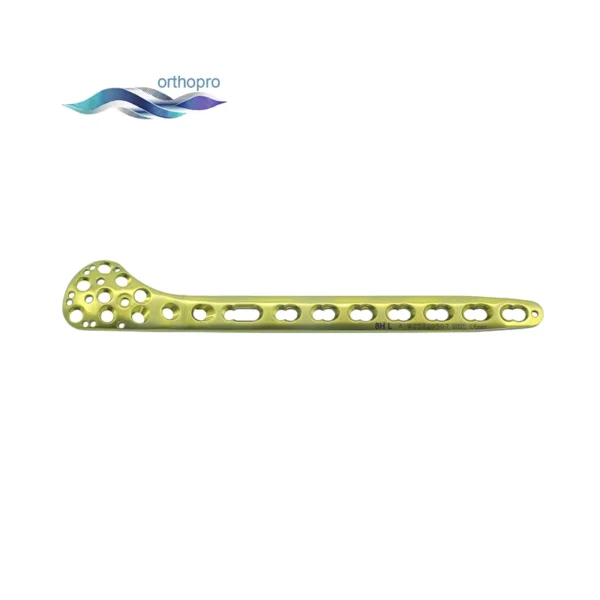
Proximal Humeral Locking Plate III – Titanium Shoulder Fracture Fixation System | Orthopedic Trauma Implants
The OrthoPro Proximal Humeral Locking Plate III is expertly engineered for the internal fixation of complex fractures of the humeral head. Featuring a low-profile anatomical design, this proximal humeral locking plate offers superior stability in osteoporotic bone through multi-planar screw
The Formula: Calculating the Real Cost
Let’s get nerdy for a minute. You can actually calculate this. If you want to present a case to your CFO for Cost-effective trauma solutions like those we offer at OrthoPro, you need to show them the “Total Cost of Care” equation.
It looks something like this:
Total Cost = Upfront Implant Cost + (Probability of Failure × Cost of Revision)
Let’s run a hypothetical scenario comparing a generic “Budget Brand” versus a “Premium Tier” implant (like our Proximal Humeral Locking Plate III).
Note: The Revision Cost includes re-hospitalization, new surgery, antibiotics, and litigation risk.
Comparison Table: The Hidden Expense
| Cost Factor | Budget Solution (Generic) | Premium Standard (OrthoPro) |
| Unit Price (Sticker Price) | $150 | $350 |
| Failure Rate (Non-union/Breakage) | 6% | 1.5% |
| Avg. Cost of Revision Surgery | $12,000 | $12,000 |
| Weighted Risk Cost | $720 (6% of $12k) | $180 (1.5% of $12k) |
| TRUE COST PER PATIENT | $870 | $530 |
Look at those numbers.
The “Cheap” plate actually costs the hospital $340 more per patient when you factor in the risk of failure. This is the argument you need to take to your administration. Reoperation costs are the silent killer of hospital margins.
Why Materials Matter (More Than You Think)
You might think, “Titanium is Titanium, right?”
Wrong.
There is a massive difference between Grade 2 Titanium (commercially pure) and Ti-6Al-4V ELI (Extra Low Interstitial) alloy.
Budget manufacturers often cut corners here. They might use raw material that hasn’t undergone proper fatigue testing.
Take the Proximal Humeral Locking Plate III as a prime example. The proximal humerus is a nightmare for surgeons because the bone quality is often poor (osteoporotic). If the screw threads aren’t engineered with perfect tolerance to lock into the plate, the screws will back out (the “windshield wiper” effect).
If you are buying a generic plate where the locking mechanism is just “good enough,” you are asking for a varus collapse. The femoral head drops, the shoulder fails, and the patient is back in your hospital complaining of pain.
At OrthoPro, we don’t mess around with material science. We use premium alloys because we know that a $50 saving on metal isn’t worth a lawsuit.
A Real World Case Study (Anonymous)
I want to share a story from a mid-sized trauma center in Southeast Asia I worked with a few years back.
The Situation:
The hospital administration mandated a switch to the lowest bidder for all small fragment sets. They saved about 35% on their annual procurement budget. The procurement officer got a bonus.
The Fallout:
Six months later, the Orthopedic Head of Department threatened to quit. Why?
- Instrument breakage: The screwdrivers provided with the cheap sets kept snapping.
- Delayed unions: They saw a 12% spike in non-unions for distal radius fractures.
- Waste: Surgeons were opening two or three packs per surgery because the first screw didn’t feel “right.”
The Fix:
They realized that “cheap” was destroying their reputation. They switched to a strategy of “Affordable Quality”—finding a supplier that offered ISO-certified, top-tier engineering without the massive marketing markup of the “Big 3” US giants.
They brought in OrthoPro.
The Result:
The non-union rate dropped back to the baseline (under 2%). OR times improved by an average of 15 minutes per case because the instrumentation actually worked.
How to Build a “Hospital Procurement Strategy” That Works
So, how do you navigate this? You can’t just buy the most expensive stuff, but you can’t buy junk.
Here is a roadmap for a balanced Hospital procurement strategy:
1. Demand Fatigue Test Data
Don’t just ask for a price list. Ask the supplier for their fatigue testing reports. If they hesitate or send you a generic certificate, run. At OrthoPro, we are transparent about our testing.
2. The “Surgeon Feel” Test
Before you sign a contract, get the instruments in your surgeons’ hands. Let them feel the weight of the drill guide. Let them drive a screw into a sawbone. If the tactile feedback isn’t there, the surgery will be clumsy.
3. Look at the “Middle Market”
This is the sweet spot.
- Top Tier (Big Pharma brands): Great quality, but you are paying for their 500 sales reps and Super Bowl ads.
- Bottom Tier: Scary quality, dirt cheap.
- The OrthoPro Tier: The same machinery and materials as the Top Tier, but a lean business model that passes savings to you.
Why OrthoPro?
We aren’t trying to be the cheapest option on Alibaba. We never will be.
Our brand, OrthoPro, is built for the professional B2B buyer who understands that quality is a safety feature. We focus on B2B clients outside of China who need reliable, certified implants that pass strict regulatory audits.
When you buy from us, you get:
- Traceability: We know where every batch of Titanium came from.
- Consistency: Plate #1 and Plate #10,000 are identical.
- Support: Real humans answering your emails at info@orthopro.mx.
FAQ: Questions We Get from Procurement Officers
Q: Can premium implants really reduce legal liability?
A: Absolutely. If an implant breaks and it’s determined to be a material defect from a sub-standard manufacturer, the hospital can be liable for negligence in procurement. Using reputable, certified implants protects your institution.
Q: How do we transition suppliers without disrupting surgery schedules?
A: It requires a phased approach. We recommend starting with trauma sets for specific anatomies (like ankle or distal radius) to prove the concept. Our team at OrthoPro specializes in smooth inventory transitions.
Q: Do you offer samples for our VAC (Value Analysis Committee)?
A: Yes. We believe the product sells itself. Contact us to arrange a demo set for your committee to evaluate.
Q: Is shipping expensive for international B2B orders?
A: Logistics is part of the cost analysis. We have optimized shipping routes to ensure that even with freight, the landed cost remains highly competitive against local distributors of major brands.
Conclusion: Stop Buying Liabilities
Every time you sign a purchase order for a sub-standard implant, you aren’t buying an asset; you’re buying a potential liability.
The math is clear. High-quality implants reduce total hospital costs. They get patients out of beds faster, keep them out of the OR for revisions, and keep your surgeons happy.
Don’t let the sticker price fool you. Invest in Cost-effective trauma solutions that actually work.
Ready to audit your current trauma spend? Let’s look at your usage and see where OrthoPro can improve your bottom line while upgrading your quality.
Request a Quote Today or drop us an email at info@orthopro.mx. Let’s build a smarter procurement strategy together.