Let’s be real. If you are reading this, you are probably staring at a spreadsheet right now. You’re looking at the price of wholesale trauma plates from a top-tier US or Swiss brand, and then you’re looking at the price of similar implants from China.
The gap is massive.
You want those margins. But you are also terrified. You’re worried about a container of titanium screws getting stuck in customs for three months. You’re worried about receiving a box of metal that looks right but fails the mechanical stress test. You’re worried about the regulatory headache of importing medical devices from China.
I’ve been in this industry for over 15 years. I’ve seen distributors make millions by streamlining their supply chain management. I’ve also seen guys lose their shirts because they didn’t know the difference between FOB and EXW, or because they forgot to check if the wooden pallets were fumigated.
This isn’t a generic “how-to” guide. This is a deep dive into the messy, complex, profitable world of orthopedic shipping logistics. We are going to fix your supply chain anxiety.
The “China Price” vs. The “China Risk”
First off, let’s kill the myth that “Chinese stuff is junk.” That was true maybe 20 years ago. Today? China is the factory of the world for a reason. Many of the “big name” brands you buy are actually OEM manufactured in Jiangsu or Changzhou, rebranded, and sold to you at a 500% markup.
When you buy from a dedicated manufacturer like OrthoPro, you are cutting out the middleman. But with great power comes great responsibility—specifically, the responsibility of getting the goods from our door to yours without the government seizing them.
The Real Cost Calculation (It’s not just the Unit Price)
Don’t just look at the catalog price. You need to calculate the Landed Cost. If you don’t know your Landed Cost, you aren’t doing business; you’re gambling.
Here is the formula I use. It’s simple text, no fancy math needed:
Landed Cost = (Unit Cost of Implants) + (Shipping Fees) + (Insurance) + (Import Duties) + (Local Port Handling Charges) + (Customs Broker Fees)
If you buy a Proximal Humeral Locking Plate III for $X, that is just the starting line.
1. The Regulatory Minefield: Clearing the Path
Before we even talk about ships and planes, we have to talk about paperwork. If your paperwork is wrong, your implants are trash. They will sit in a bonded warehouse racking up storage fees until you pay to have them destroyed.
The Basics: ISO 13485 and CE
If a factory tries to sell you orthopedic implants and they don’t have ISO 13485, hang up the phone. Seriously. ISO 13485 is the global standard for Quality Management Systems in medical devices. It proves they aren’t making plates in a garage.
But here is where people trip up: ISO is not a permission to sell.
To clear customs in many territories, you need more.
- Europe: You need the CE Mark. And not just any CE. With the new MDR (Medical Device Regulation), it’s gotten harder. Ensure your supplier is compliant with the latest standards.
- USA: FDA 510(k) clearance.
- Mexico/LATAM: This is our backyard. You often need the Certificate of Free Sale (CFS) from the country of origin.
Pro Tip: At OrthoPro, we provide the CFS issued by the Chinese NMPA (National Medical Products Administration). This is the “Golden Ticket” for registering products in countries like Mexico, Brazil, or Thailand. If your supplier can’t give you an NMPA-backed Free Sale Certificate, you might struggle to register the products locally.
The HS Code Trap
Customs brokers are not orthopedic surgeons. If you label your box “Medical Stuff,” they will flag it. You need the specific Harmonized System (HS) Code.
For most orthopedic implants (plates, screws, nails), the magic number is usually under heading 9021.10 (Orthopedic or fracture appliances).
- Wrong Code: You pay too much duty (or get fined).
- Right Code: You pay the correct duty (often lower for medical goods).
Make sure your commercial invoice lists the HS Code clearly for every single SKU.
2. Orthopedic Shipping Logistics: Air vs. Sea
You have an order of 500 locking plates and 2,000 screws. How do you get them home?
This is a classic battle in supply chain management: Speed vs. Cost.
Air Freight (The “I need it yesterday” option)
- Couriers (DHL/FedEx/UPS): Great for samples or tiny orders (under 50kg). Door-to-door. Expensive as hell.
- Air Cargo: You book space on a passenger or cargo plane. It goes Airport-to-Airport. You need a truck to pick it up.
- Timeline: 3 to 7 days.
- Cost: High. You pay by “chargeable weight” (volume weight vs. actual weight).
Sea Freight (The Profit Maker)
- LCL (Less than Container Load): You share a container with other people. Good for 1-5 pallets.
- FCL (Full Container Load): You rent the whole 20ft or 40ft box.
- Timeline: 25 to 45 days (depending on destination).
- Cost: Dirt cheap per unit.
Comparison Table: Moving 500kg of Implants to Mexico
| Feature | Air Cargo | Sea Freight (LCL) |
| Transit Time | 5 Days | 35 Days |
| Approx Cost | | $ |
| Risk of Damage | Low | Medium (needs better packing) |
| Customs Process | Fast | Slower |
| Best For | Emergency Trauma Stock | Stock Replenishment |
My advice? Plan your inventory. Use sea freight for 90% of your wholesale trauma plates. Use air freight only when you have a specific hospital tender you need to win now.
3. Incoterms: Who Pays for What?
I’ve seen grown men cry over Incoterms. These are the 3-letter codes that decide who pays for the shipping and, more importantly, who is liable if the ship sinks.
When you ask for a quote from OrthoPro or any other factory, be specific.
- EXW (Ex Works): The price is for the product sitting on our factory floor. You have to arrange the truck to pick it up, the export customs in China, the freight, everything. Don’t do this unless you have a logistics office in China.
- FOB (Free On Board): This is the industry standard. We pay to get the goods to the port (Shanghai/Ningbo) and clear Chinese export customs. Once it crosses the ship’s rail, it’s your problem. This gives you control over the ocean freight costs.
- CIF (Cost, Insurance, Freight): We pay for everything up to your port. Sounds great, right? Careful. Sometimes suppliers use the cheapest, slowest shipping line to save money.
- DDP (Delivered Duty Paid): The VIP service. We handle everything right to your door, including taxes. It’s the easiest, but it will be the most expensive price per unit.
Recommendation: stick to FOB if you have a reliable freight forwarder. It gives you the best balance of control and cost.
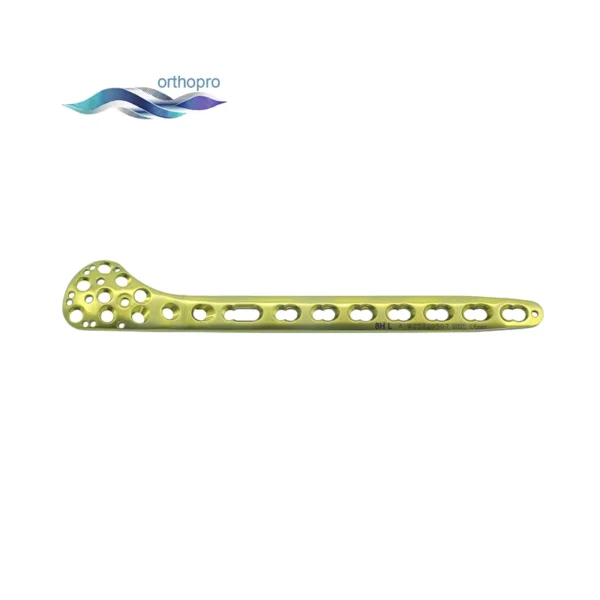
Proximal Humeral Locking Plate III – Titanium Shoulder Fracture Fixation System | Orthopedic Trauma Implants
The OrthoPro Proximal Humeral Locking Plate III is expertly engineered for the internal fixation of complex fractures of the humeral head. Featuring a low-profile anatomical design, this proximal humeral locking plate offers superior stability in osteoporotic bone through multi-planar screw
4. Lead Times Explained (The “Waiting Game”)
Here is where I have to be brutally honest. If a supplier tells you “lead time is 3 days” for a bulk order, they are lying, or they are sending you old stock that’s been sitting on a shelf gathering dust.
Orthopedic manufacturing is precise. We don’t just stamp these out like plastic toys.
The Production Cycle
Let’s look at the lifecycle of a Proximal Humeral Locking Plate III:
- Raw Material Prep (5-7 Days): We source medical-grade Titanium (Ti6Al4V). We test the material before we even cut it.
- Machining (10-15 Days): CNC milling. This takes time. The locking threads need to be perfect.
- Surface Treatment (3-5 Days): Anodization. This isn’t just for color; it’s for biocompatibility.
- Cleaning & Passivation (2 Days): Removing any manufacturing oils.
- Quality Control (3 Days): We measure tolerances. We check surface finish.
- Packaging & Sterilization (5 Days): If you buy sterile, we need to EO sterilize and quarantine the batch to ensure sterility.
Total Realistic Lead Time: 30 to 45 Days for production.
Plus Shipping: 30 Days.
Total Time to Warehouse: ~75 Days.
You need to forecast. If you wait until you are out of stock to order, you are already too late.
5. Case Study: The “Pallet” Incident
Let me share a quick story (names changed to protect the guilty).
A client in Brazil ordered $50,000 worth of trauma implants from a different supplier in Jiangsu. They wanted to save money, so they beat the supplier down on price until there was zero margin left.
The supplier agreed. To save $50, they shipped the goods on raw wood pallets instead of plywood or plastic.
When the shipment arrived in Santos, Brazilian customs saw the raw wood. Raw wood requires a fumigation certificate (ISPM 15) to prevent bugs from entering the country. The supplier didn’t provide it.
Result: The entire shipment—$50k of perfect titanium implants—was rejected. It had to be shipped back to China at the client’s expense. They lost three months and about $8,000 in freight.
The Lesson: Details matter. At OrthoPro, we use plywood or plastic pallets for all exports. We don’t mess around with bio-security regulations.
6. Customs Clearance Medical Implants: The Final Boss
You’ve waited 40 days. The ship has docked. Now you face the Customs Officer.
To beat this boss, you need a “Documentation Pack” that is bulletproof. When we ship to you, we prepare:
- Commercial Invoice: With exact values and HS Codes.
- Packing List: Weight, dimensions, lot numbers.
- Bill of Lading (B/L): The proof of ownership.
- Certificate of Origin: This can save you money! Many countries have trade agreements with China. A proper CO can reduce your import tax to 0%.
- Quality Certificates: Sterility certs, Material Analysis certs.
A note on “Undervaluing”:
Don’t ask us to declare a lower value on the invoice to save on taxes. Customs officers aren’t stupid. They know a locking plate doesn’t cost $5. If you get caught, your company gets blacklisted, and your goods get seized. Pay your taxes, sleep better at night.
Why Trust OrthoPro with Your Supply Chain?
Look, anyone can buy a CNC machine and make a screw. The difference is the service.
We understand that importing medical devices from China is scary for a B2B buyer. That’s why we act more like a logistics partner than just a factory.
- We help with registration: We provide the technical dossiers you need for your local Ministry of Health.
- We handle the packing: Double-boxing, reinforced corners, moisture protection.
- We are transparent: If production is delayed by a week because we failed a QC check, we tell you. We’d rather be late than send you a defective implant.
We are focused on the long game. We want you to order from us for the next 10 years, not just once.
FAQ: Questions I Get Asked Daily
Q: Can you ship DDP (Delivered Duty Paid) to my country?
A: In many cases, yes. We have partners in logistics who can handle the import duties and deliver directly to your warehouse. This is great for smaller distributors who don’t have a customs broker. However, for large volumes, doing it yourself (FOB) is usually cheaper.
Q: What is the Minimum Order Quantity (MOQ) for a private label order?
A: We are flexible. For standard items like the Proximal Humeral Locking Plate, we can start small. But to make the shipping cost worth it, we recommend a minimum weight of 45kg (roughly a small pallet). Contact us to discuss specifics.
Q: How do you handle sterilization during shipping?
A: If you order non-sterile (which is common for distributors who sterilize locally), we pack in clean PE bags. If you order Sterile, we use Tyvek pouches and EO sterilization, valid for 3-5 years. The shipping cartons are reinforced to prevent the Tyvek from being punctured during transit.
Ready to Streamline Your Procurement?
Stop gambling with your supply chain. You need a partner who understands both the engineering of the implant and the engineering of the shipment.
If you are looking for Customs clearance medical implants support and a reliable source for high-quality trauma products, let’s talk.
Check out our full range of products at OrthoPro or drop us a line at info@orthopro.mx. Let’s get your first shipment moving—correctly.