Procurement in the medical device sector is a totally thankless job. You spend weeks hunting down the right equipment, fighting with budgets, and negotiating with international vendors. But if one handpiece fails mid-operation, the chief of orthopedic surgery is suddenly in your office screaming about it.
Buying surgical tools isn’t like buying office chairs or generic hospital beds. The stakes are massive. And when you are specifically looking to source a mini orthopedic drill for small bone procedures—like hand, wrist, or foot reconstruction—the margin for error drops to zero.
I’ve been involved in the medical supply chain for years, and here is a controversial opinion that will probably make some legacy brands mad: you are getting ripped off. The massive, multi-billion dollar medical device conglomerates are routinely charging a 300% to 400% markup on small bone power tools just for the logo stamped on the side of the anodized aluminum.
You don’t need to blow your entire annual department budget on three drills from a legacy brand just to get clinical reliability. But you also can’t gamble on cheap, unverified knockoffs from random overseas traders.
Let’s break down exactly what you should actually be looking at when evaluating hand & foot surgery equipment, so you can make a purchase that keeps both your finance department and your surgical team happy.
The Big Lie About “More Power” in Small Bone Surgery
I see B2B buyers do this all the time. They pull up two spec sheets, look at the max RPM or the battery voltage, and assume the higher number is automatically the better tool.
That logic works if you are buying a chainsaw. It’s terrible logic for a mini orthopedic drill.
When a surgeon is working on delicate metacarpal bones in the hand, or doing intricate maxillofacial work, raw speed can actually be dangerous. Bone tissue is incredibly sensitive to heat. According to established orthopedic research, thermal necrosis (bone cell death) occurs when bone temperature reaches just 47 degrees Celsius for more than one minute.
If you buy a drill that spins at 40,000 RPM but has terrible torque control, the friction from the drill bit will literally cook the surrounding bone tissue. This leads to delayed healing, implant failure, and massive post-op complications.
What you actually want to look for is the balance between Torque (rotational force) and Speed (RPM).
In plain text, the relationship looks like this:
Power (Watts) = [Torque (Nm) * Speed (RPM)] / 9.5488
For a solid mini multi-functional drill, you want a motor that can deliver steady, sustained torque at lower speeds for drilling cortical bone, while still having the burst capability for K-wire driving or sagittal sawing. A true surgical drill supplier will happily provide the torque curve graphs of their brushless DC motors. If a vendor just shouts “high RPM!” and dodges your questions about torque, cross them off your list.
The Holy Trinity of Hand & Foot Surgery Equipment
When I evaluate a new supplier or a new product line for small bone trauma, I filter everything through three main categories. If a drill fails any of these three, it’s garbage.
1. Weight and Ergonomic Balance (The Wrist Factor)
Small bone surgery is highly meticulous. A surgeon might spend three hours doing a complex foot reconstruction, constantly picking up and putting down the power tool.
If the handpiece with the battery attached weighs more than 900 grams, you are going to cause severe surgeon fatigue. A heavy, poorly balanced drill causes hand tremors. Hand tremors during a delicate osteotomy are a disaster.
But it’s not just the total weight; it’s the center of gravity. A lot of cheap drills have the battery awkwardly hanging off the bottom like a construction tool, which pulls the surgeon’s wrist downward. The best small bone power tools distribute the weight evenly across the web of the hand.
2. Interface Compatibility (The Attachment Problem)
This is where hospitals bleed money. You buy a drill, and then you realize that every single time you need a different saw blade or a specific chuck, you have to buy it directly from the original brand at insane prices.
The industry term for this is a “closed ecosystem.” It’s the printer-ink business model applied to surgery.
When you are sourcing, you need to look at the orthopedic drill attachments. You want universal compatibility wherever possible. A good multi-functional system should easily swap between:
- AO quick couplings (the absolute standard for drills and screwdrivers)
- Jacobs chucks (with the key, for holding non-standard K-wires or pins)
- Sagittal saw attachments
- Cannulated drill heads (crucial for passing guide wires)
If a supplier tries to lock you into their proprietary attachment interface, run away. It will wreck your consumable budget for the next ten years.
3. The Sterilization Survival Rate
Here is a fun fact: the number one reason orthopedic drills die isn’t from being dropped. It’s from being boiled alive.
Every time a drill is used, it has to go into an autoclave sterlization machine. The standard medical autoclave cycle hits 134 degrees Celsius (273 degrees Fahrenheit) at high pressure for up to 18 minutes. Water vapor gets pushed into every single microscopic crack in the tool.
Cheap drills use low-grade rubber O-rings and basic brushed motors. After about 30 or 40 autoclave cycles, the moisture breaches the casing, rusts the motor contacts, and shorts out the battery.
You need to ask your vendor about their IP rating (Ingress Protection) and their internal sealing mechanisms. High-end drills use PEEK (Polyether ether ketone) components and specialized high-temp epoxies to seal the internal electronics. A quality brushless motor system should comfortably survive hundreds of sterilization cycles without any degradation in performance.
Don’t Get Burned: How to Vet a Surgical Drill Supplier
Anyone can set up a shiny website and call themselves a medical manufacturer. I’ve dealt with “factories” that turned out to be two guys in a rented office dropshipping unverified tools.
When you are buying B2B, you are putting your company’s reputation on the line. Here is how you filter out the noise.
First, demand to see their ISO 13485 certificate. Not a generic ISO 9001, but the specific 13485 standard for medical device quality management. And don’t just look at the PDF they email you—actually verify the certificate number with the issuing body.
Second, ask about battery chemistry and replacement costs. Small bone drills use lithium-ion battery packs that have to endure massive heat stress. Even the best batteries degrade after about a year or two of daily hospital use. A shady supplier will sell you the drill cheap, but then charge you $800 for a replacement battery pack. Get the replacement parts price list before you sign the initial purchase order.
Finally, look for a brand that actually understands cross-border compliance. If you buy a batch of drills and they get seized by customs because the vendor didn’t provide the right UN38.3 battery transit documents or the proper CE/FDA paperwork, you just flushed your money down the drain.
This is exactly why companies like OrthoPro exist. We bridge the gap between engineering reality and procurement headaches. We handle the brutal compliance paperwork so you don’t have to.
Real-World Case Study: The Cost of Cheap Sourcing
I’ll keep the client anonymous, but let’s look at a private orthopedic clinic network based in Brazil.
Their purchasing director was under massive pressure to cut capital expenditure costs. They found a supplier on a B2B portal offering mini bone drills for practically nothing. They ordered 15 units for their hand and trauma departments.
Within two months, it was a total nightmare.
The first issue was compability. The sagittal saw attachments on the cheap drills used a bizarre proprietary locking mechanism, meaning the clinic couldn’t use their existing stock of universal saw blades. They had to special-order blades from the overseas factory, which took four weeks to arrive. Surgeries were delayed.
Then the batteries started dying. Because the internal seals were cheap, autoclave moisture was seeping into the battery housing. Out of the 15 units, 8 were completely dead within 90 days.
The clinic had to scrap the entire batch. They eventually reached out to a professional brand and bought proper, fully sealed, multi-functional units. The “cheap” route ended up costing them almost double in the long run, not to mention the total loss of trust from their surgical staff.
Feature Breakdown: What a Good Spec Sheet Looks Like
To make your life easier, here is a quick comparison table of what you usually see from a sketchy vendor versus what you should expect from a professional grade medical device.
| Feature Category | The Sketchy Unverified Drill | A Professional Mini Orthopedic Drill |
| Motor Type | Brushed DC (Generates carbon dust) | High-torque Brushless DC (Zero maintenance) |
| Autoclave Rating | “Wipe clean only” or low temp | Fully autoclavable at 134°C / 0.22MPa |
| Attachments | Fixed head or proprietary | Quick-release AO, Jacobs, Saw, Wire driver |
| Weight | 1.2 kg+ (Causes wrist fatigue) | ~700g to 850g perfectly balanced |
| Noise Level | > 80 dB (Loud, annoying in OR) | < 65 dB (Smooth, quiet operation) |
| Documentation | None or fake PDFs | Verified ISO 13485, CE, full traceability |
The OrthoPro Solution: Built for the Reality of the OR
If you are tired of playing guessing games with overseas suppliers, you need to look at equipment that is purposely built to solve these exact problems.
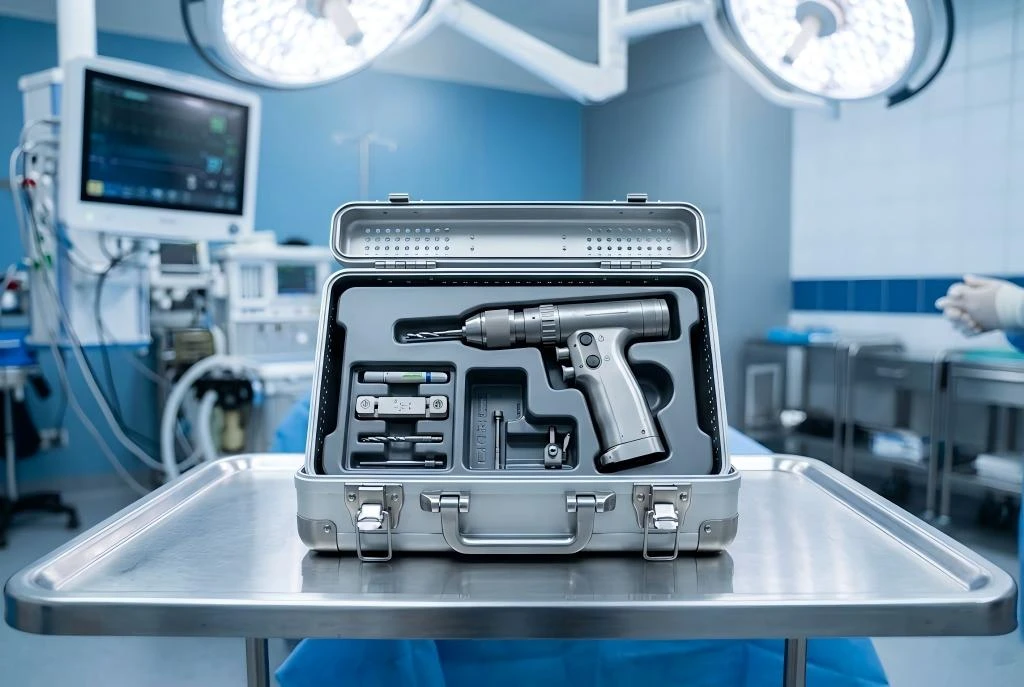
Take a look at the OrthoPro Mini Multi-functional Orthopedic Drill.
We didn’t just slap a motor in a metal tube. We engineered this specific system for the brutal realities of small bone trauma, podiatry, and veterinary micro-surgery.
It uses a premium brushless motor that delivers the exact torque curve needed to prevent thermal bone necrosis, while giving the surgeon incredibly precise trigger-control. We built it around a modular quick-change system. You can swap from a cannulated drilling head to a reciprocating saw in about two seconds flat, right in the sterile field.
More importantly for you as a buyer, it uses standard interfaces. You aren’t going to be locked into buying insanely priced proprietary consumables for the next decade.
When you source through OrthoPro, you are getting the rigorous ISO 13485 quality control, the verified autoclave survivability, and the transparent international shipping documentation that prevents your cargo from getting stuck at customs. It’s clinical-grade reliability without the legacy-brand extortion.
FAQ on Buying Small Bone Power Tools
I get bombarded with questions from procurement teams every week. Here are the three things people ask me the most.
Do I really need a cannulated drill for small bone surgery?
Yes, absolutely. A cannulated drill has a hollow channel running right through the center of the handpiece. In hand and foot surgery, doctors constantly use K-wires (Kirschner wires) to temporarily pin tiny fractured bones together or to act as a guide path for cannulated screws. If your drill isn’t cannulated, the surgeon can’t slide the drill over the guide wire. It is an absolute must-have feature for any multi-functional system.
How many batteries should I order per handpiece?
The golden rule in hospital procurement is two batteries per tool, minimum. While one battery is being used in surgery, the other is either in the autoclave being sterilized or on the charging dock. If you only buy one battery per drill, that tool is completely out of commission for hours between cases while it goes through sterile processing. Always buy a backup.
Can I use the same drill for both human and veterinary surgery?
Technically, the bone density of a human wrist and a medium-sized dog’s leg are quite similar, and the mechanical requirements for the drill are identical. Many veterinary clinics buy high-end human-grade orthopedic tools because they are built to much stricter quality standards. However, from a regulatory standpoint, human hospitals cannot use tools that are legally classified and sold exclusively for vet use. Our multi-functional drills are manufactured to the highest human clinical standards.
Let’s Talk Specs and Pricing
Sourcing reliable medical equipment shouldn’t feel like navigating a minefield. You need a vendor who actually understands the technical demands of the operating room and the logistical realities of international B2B trade.
You don’t want to be the buyer who saved 10% on the initial purchase price, only to spend the next two years apologizing to your surgical team for equipment that constantly jams or batteries that won’t hold a charge.
Stop gambling with your facility’s budget.
If you are ready to equip your trauma teams with hand & foot surgery equipment that actually performs, we need to talk. We can walk you through the exact technical specifications, provide you with our verified quality certifications, and put together a transparent, no-nonsense quote for your facility.
Head over to our contact page to get in touch with our technical sales team, or just shoot me an email directly at info@orthopro.mx. Let’s get you the reliable tools you need so you can stop worrying about equipment failures and get back to doing your job.