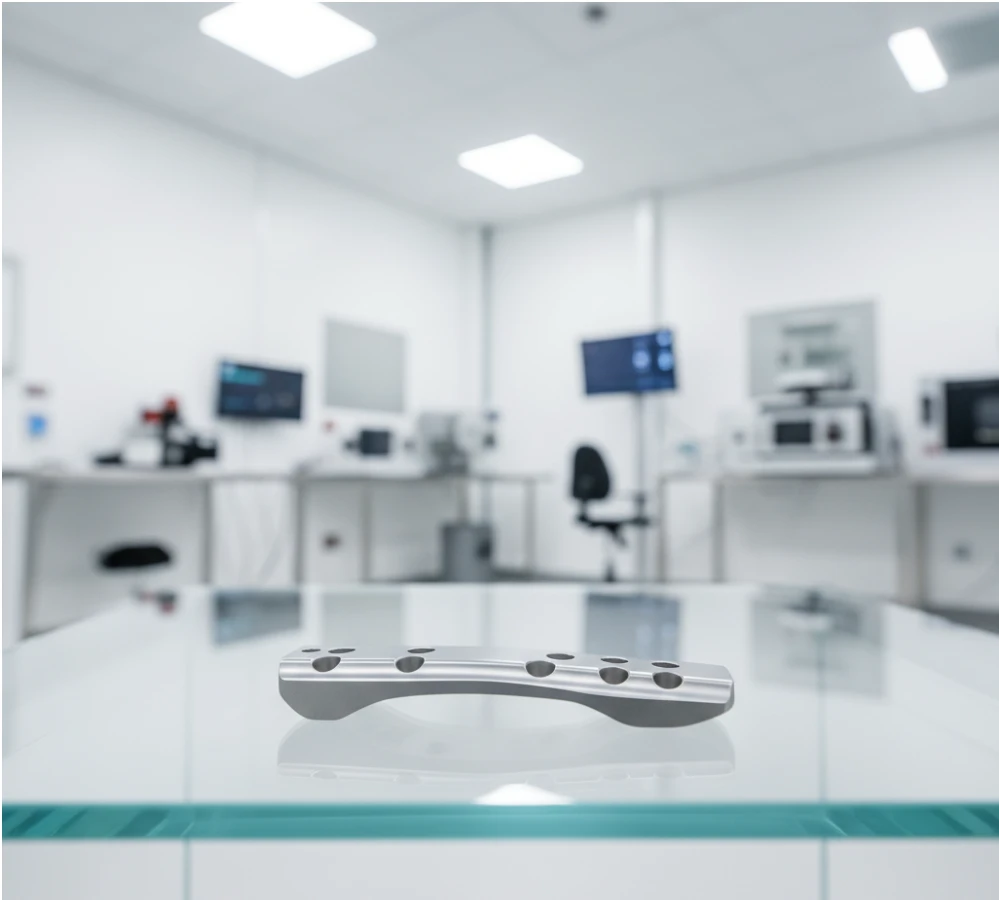
Sourcing medical devices is a headache. I’ve been in the orthopedic game for a long time, and I know exactly how it goes. You get twenty catalogs on your desk, and every single one of them claims they have the “best” Distal Medial Femoral Osteotomy (MDFO) Locking Plate. They all look shiny in the photos. They all have the right certificates. But once they hit the operating room, that’s when the real story comes out.
If you’re a procurement manager or a distributor looking to stock up on Distal Medial Femoral Osteotomy Locking Plate options, you can’t just gamble on price. You need a way to cut through the marketing fluff and find a supplier that actually understands orthopedic trauma plate quality.
Let’s skip the corporate talk and get into the weeds of what makes a plate actually work—and how you can spot a lemon before it’s too late.
Why MDFO Plates are a Different Beast
Unlike a standard shaft plate, a distal medial femoral plate has to handle some weird forces. You’re dealing with a valgus deformity correction. You’re literally cutting a bone and asking a piece of metal to hold the weight of a human being while that bone tries to knit back together.
If the plate is too stiff, you get “stress shielding” (where the bone doesn’t work hard enough and gets weak). If it’s too soft, it’ll fatigue and snap before the six-month mark. Most people don’t realize that the medial side of the femur is under constant compression and tension cycles that are way more aggressive than other parts of the body.
The “Must-Check” List for Medical Device Manufacturing
When you’re vetting a partner like OrthoPro, or anyone else for that matter, you need to look at the manufacturing pedigree. It’s not just about the final product; it’s about the process.
1. ISO 13485 Implants: The Minimum Entry Fee
If a factory doesn’t have a solid ISO 13485 certification, just walk away. It’s not just a piece of paper. It means they have a system to track every single screw and plate back to the original batch of raw titanium. If a plate fails in a patient three years from now, you need to be able to pull up the records and see exactly what happened during production.
2. The Material: Titanium vs. Stainless Steel
Most B2B buyers ask for “Titanium,” but do you know which grade?
- Grade 5 (Ti-6Al-4V): This is the gold standard. It has a high strength-to-weight ratio and amazing fatigue resistance.
- Grade 2 (Pure Titanium): Too soft for an MDFO plate.
- 316L Stainless Steel: Still used, very strong, but way heavier and less biocompatible than Ti.
I’ve seen some “budget” suppliers use lower-grade alloys that feel the same but fail the “Bend Test” miserably. Speaking of which, let’s look at some numbers.
Material Strength Comparison (The Real Data)
| Property | Titanium Alloy (Grade 5) | Stainless Steel (316L) | Why it matters for MDFO |
| Tensile Strength | 860 – 900 MPa | 480 – 580 MPa | Higher is better for heavy loads. |
| Yield Strength | 790 MPa | 190 MPa | Tells you when the plate will permanently deform. |
| Density | 4.43 g/cm3 | 7.95 g/cm3 | Weight affects patient comfort and MRI interference. |
| Modulus of Elasticity | 110 GPa | 193 GPa | Ti is closer to bone, reducing stress shielding. |
Technical Specs Most Buyers Miss
When you are looking at the OrthoPro catalog, pay attention to the hole design. A common mistake I see in medical device manufacturing is the “Combi-hole” precision.
If the threads inside the locking hole are even a fraction of a millimeter off, the screw won’t seat properly. If the screw isn’t locked, it’s not a locking plate—it’s just a very expensive piece of scrap metal. A good plate should allow for:
- Dynamic Compression: To pull the bone ends together.
- Rigid Locking: To keep the angle perfect.
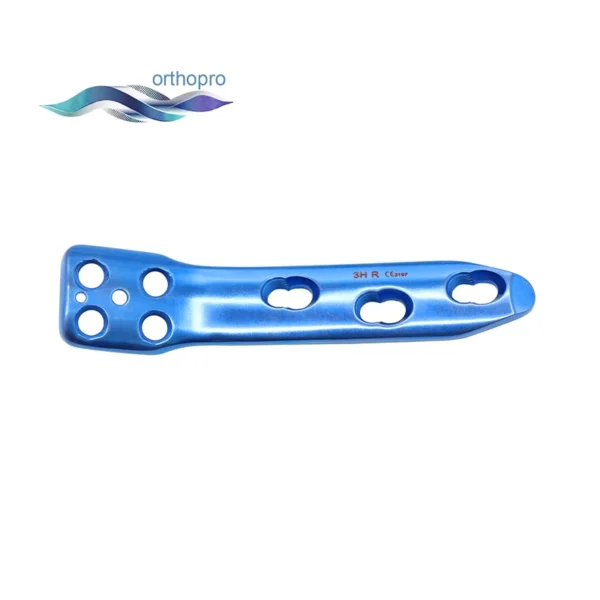
Distal Medial Femoral Osteotomy Locking Plate | Titanium MDFO Plate for Varus Deformity Correction & Knee Realignment Surgery
The Distal Medial Femoral Osteotomy Locking Plate is precision-engineered for varus deformity correction and knee realignment procedures. This high-performance MDFO locking plate provides rigid internal fixation for medial distal femur osteotomy cases. OrthoPro’s distal medial femoral plate features a low-profile design to ensure superior surgical outcomes and minimal soft tissue irritation.
The Math of Stability (Simplified)
You don’t need to be an engineer, but you should understand the “Stress Concentration” factor.
In a plate, the stress (S) is usually calculated as:
S = Force / Cross-Sectional Area
However, at the screw holes, that stress can triple. If the manufacturer hasn’t rounded the edges of the holes (filleting), the plate is 3x more likely to crack at that point. I’ve seen cheap plates that look like they were cut with a hacksaw under a microscope. You want smooth, polished transitions.
Surface Finish: More Than Just Looking Pretty
Have you ever noticed that some plates are bright blue, green, or pink? That’s not for fashion. It’s Type II Anodization.
This process creates a hardened surface layer that:
- Prevents “Cold Welding” (where the screw gets stuck in the plate forever).
- Reduces metal ion release into the body.
- Makes the plate more resistant to bacteria colonization.
If your supplier is just “polishing” the plates and not anodizing them, they are cutting corners. Ask them about their surface treatment protocol. If they stutter, move on.
A “Real World” Scenario (Anonymous Case Study)
Last year, a distributor I know switched to a “budget-friendly” supplier for their MDFO plates to save about 15% on costs. Within six months, they had two “non-union” cases where the plates had de-bent—not snapped, but actually bent under the patient’s weight during early walking.
The hospital was furious. The distributor had to recall the entire batch, which cost them 10x what they “saved.”
When they switched back to a high-spec ISO 13485 implants provider like OrthoPro, the complaints stopped. Why? Because the high-spec plates used cold-worked Titanium that had a much higher yield strength. Sometimes, “cheap” is the most expensive thing you can buy.
How to Audit a Supplier Without Flying to the Factory
Since you probably can’t jump on a plane every time you need to buy trauma plates, here is a quick “Desk Audit” you can do:
- Request the Fatigue Test Report: Every plate design should have a report showing it survived 1,000,000 cycles of stress without breaking. If they can’t show you this, they haven’t tested it.
- Check the “Burr” Policy: Ask how they remove sharp edges. Hand-polishing is okay, but robotic finishing is better for consistency.
- Look at the Screw Compatibility: Does the plate only work with their screws? Or can it handle universal 4.5mm/6.5mm standards? Flexibility is key for hospitals.
The Anatomical Fit Factor
One thing I love about a well-designed Distal Medial Femoral Osteotomy Locking Plate is when it actually fits the bone without me having to use the bending irons.
Every time you bend a plate in the OR, you are introducing “Micro-fractures” into the metal. A plate that is pre-contoured to the average femur’s medial flare is objectively safer. It keeps the low-profile design intact and prevents skin irritation, especially in thinner patients.
Comparison Table: Premium vs. Budget Plates
| Feature | Premium (e.g., OrthoPro) | Budget / Generic |
| Material Traceability | Full batch tracking to the mine. | Often missing or faked. |
| Edge Finish | Beveled and chamfered. | Sharp or inconsistent. |
| Screw Locking | High-torque tolerance. | Threads strip easily. |
| Anatomical Fit | Multi-point contouring. | Flat or simplistic curves. |
| Packaging | Sterile or high-grade non-sterile. | Basic plastic wraps. |
Why B2B Buyers are Shifting to Specialized Brands
In the old days, everyone just bought the “Big Three” brands. But now, smart procurement managers are realizing that specialized brands like OrthoPro offer the same (or better) orthopedic trauma plate quality without the 400% markup.
The trick is finding a supplier that treats the relationship as a partnership. You need a team that will answer the phone at 3 AM when a surgeon has a technical question about the screw trajectory.
Let’s Talk About Your Supply Chain
If you’re still reading, you probably care about quality more than the average buyer. That’s good. The orthopedic market is getting crowded, and the only way to stand out as a distributor is to have a reputation for “stuff that works.”
At OrthoPro, we don’t just “make plates.” We obsess over the grain structure of our titanium and the precision of our locking threads. We know that behind every purchase order is a patient who just wants to walk again without pain.
If you are ready to stop worrying about your orthopedic trauma plate quality and start working with a team that takes medical device manufacturing seriously, we should talk.
How to Move Forward:
- Audit us: Ask for our ISO certifications and technical data sheets.
- Test a Sample: See the finish for yourself under a loupe.
- Get a Quote: You might be surprised that “premium” doesn’t have to mean “overpriced.”
Reach out to us at info@orthopro.mx or visit our Contact Page to get a conversation started. We can help you build a trauma portfolio that actually wins over surgeons.
FAQ: What Buyers Usually Ask
Q1: Can I use 3rd party screws with your MDFO Locking Plates?
Honestly, we always recommend using our screws because the thread pitch is perfectly matched for maximum torque. However, our plates are designed to meet international standards for 4.5mm locking and cortex screws. If you’re in a pinch, standard-spec screws usually work, but why risk the fit?
Q2: What’s the typical lead time for a wholesale order?
It depends on the volume, but usually, we’re looking at 4-6 weeks for large stock replenishments. We keep a healthy inventory of standard sizes for emergency surgical needs.
Q3: How do you handle shipping to regions with strict customs, like Latin America or SE Asia?
We’ve been doing this for years. We provide all the necessary ISO 13485 implants documentation, Certificates of Free Sale, and origin declarations to make sure your shipment doesn’t get stuck in a warehouse for a month.
Q4: Do you offer any surgical training materials for new distributors?
Yes, absolutely. We have surgical technique guides and 3D models. We can even do a video call with your technical team to walk them through the specific advantages of the MDFO plate’s hook or screw placement.
Ready to upgrade your inventory?
Don’t settle for mediocre plates. Get the stability your surgeons demand.
Contact OrthoPro Today for a Wholesale Quote
Or email our team directly: info@orthopro.mx