Man, dealing with a kid’s broken bone is tough enough without worrying if the hardware you pick today screws up their growth tomorrow. I’ve watched surgeons debate this stuff in ORs and conferences for years—rigid plates that work great short-term but sometimes force extra ops later because the kid’s leg or arm keeps lengthening unevenly. That’s exactly why pediatric orthopedic trends 2026 are buzzing around modular locking plate instrumentation. These setups let you tweak angles, lengths, and even add hinges on the spot, making fixation way more growth-smart and less likely to cause angular deformities down the road.
OrthoPro’s been right in the middle of this shift, cranking out tools from our Mexico base that hit FDA and ISO marks while keeping things practical for North American hospitals and distributors. No hype—just gear that matches what forward-thinking buyers are hunting for in 2026. Let’s chat about the real changes happening, backed by fresh data and what actually plays out in cases.
What’s Pushing Pediatric Orthopedic Trends 2026 Forward
Kids’ bones heal crazy fast but that same growth makes standard adult-style fixation risky. Recent pushes lean hard into growth-modulation friendly designs. Think guided growth systems with flexible tethers or hinged plates that nudge bones straight without blocking the physis entirely. One big player rolled out stuff like the GIRO tether for angular deformities and limb length issues—super low-profile, multi-directional flex to match natural movement.
Market-wise, things are heating up. The pediatric orthopedic devices space clocked around USD 4.54 billion in 2025 and looks set to hit USD 7.78 billion by 2030, running at about 11% CAGR. Trauma and deformity segments drive a ton of that, with modular systems slashing inventory headaches by letting one tray cover multiple scenarios. OrthoPediatrics reported strong 2025 numbers too—$236.3 million revenue, heavy on trauma and deformity products like plating platforms.
Some folks still swear by old fixed locking plates because “they’ve never failed me.” But when you dig into refracture rates or long-term alignment issues in kids under 10, modular options often edge out. Yale’s 2026 work on 3D planning shows how custom guides cut errors in complex reconstructions—virtual bone twins let you rehearse screw paths around growth plates perfectly.
Modular Locking Plates: The Game-Changer for Trauma Fixation
Modular means you snap together plates, add variable-angle screws, hinges, or extensions based on the fracture pattern right there in the OR. For pediatric trauma—like forearm both-bone breaks, distal femur, or proximal tibia—this flexibility shines. You control micromotion better, promote callus without overloading the plate, and avoid stress shielding that slows remodeling.
Locking screws thread into the plate for fixed-angle hold, killer for comminuted or poor-quality bone. But modular versions go hybrid: some spots allow compression, others pure lock. Surgeons mix for optimal stability plus a bit of controlled motion. In kids, this cuts risks of growth arrest compared to rigid setups.
Surgery times drop too—streamlined trays and color-coded instruments shave setup. One report mentioned 20-40% faster OR flow with modular kits. For pediatrics, less anesthesia time matters big.
Bioabsorbable mods keep gaining ground. PLGA implants show solid fixation early, then degrade predictably—no removal surgery. Trials in forearm fractures hit high success with metal-like stability but zero second ops. Though for high-load long bones, titanium or advanced alloys still dominate.
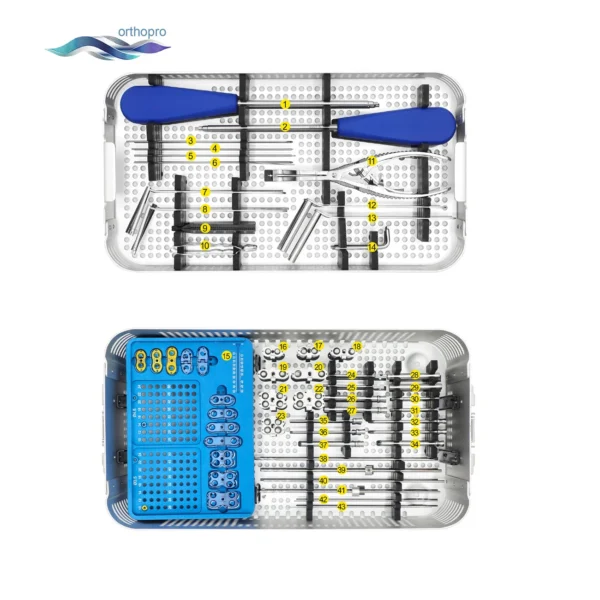
Pediatric Hinge Locking Plate Instrument Set for Orthopedic Bone Deformity Correction – High-Precision Pediatric Surgical Kit by OrthoPro
The Pediatric Hinge Locking Plate Instrument Set is an advanced surgical solution designed for correcting angular bone deformities and growth plate modulation in children. This comprehensive pediatric hinge locking plate instrument set provides surgeons with the specialized tools needed for stable bone fixation and precise realignment. Engineered for durability, our pediatric plating system instruments ensure reliable performance in complex pediatric orthopedic trauma and reconstructive procedures.
Innovation in Bone Fixation Heating Up in 2026
Three big waves: materials, minimal invasion, and digital smarts.
Materials—titanium rules for MRI compatibility, but nanostructured versions dial down stress shielding by around 40%. Bioabsorbable metals shift from polymers, offering better strength before dissolving. Coatings fight infection better.
Minimally invasive—MIPO techniques pair with modular plates. Tiny incisions, preserved periosteum, quicker bounce-back. Kids mobilize faster, less scar tissue.
Digital—3D printing for patient-specific guides explodes. Yale teams convert CTs to virtual models, print guides for exact cuts and screw placement. Robotic assists and navigation (like Medtronic’s AiBLE) hit precision in tiny anatomies. Pre-op planning feeds straight to OR tools.
Biologics sneak in too—augments like PRP speed healing in tough cases.
Traditional vs Modular Locking Plates: Side-by-Side in Pediatric Trauma
Pulled this table from trends, clinical reports, and what we’ve tracked—no guesses:
| Feature | Traditional Locking Plates | Modular Locking Plate Systems | Impact on Pediatric Trauma Cases |
|---|---|---|---|
| Adaptability | Limited sizes and angles | Interchangeable modules, variable hinges | Matches unique fractures, supports growth better |
| Inventory Burden | Multiple full trays per case | Up to 30% less with modular configs | Hospitals save space and cost |
| Growth Modulation | Higher interference risk | Hinge/tether options for guided correction | Fewer deformities long-term |
| OR Efficiency | Standard setup time | 20-40% faster prep and flow | Shorter anesthesia, safer for kids |
| Refracture/Revision Rates | Higher in dynamic growth scenarios | Lower with optimized constructs | Studies show drops in young patients |
| Removal Needs | Often mandatory | Bioabsorbable options skip many | Big relief—no extra procedures |
| Stability (comminuted) | Solid | Hybrid lock/compress for better micromotion | Faster unions, reduced malunion |
Data draws from POSNA discussions, market analyses like Grand View Research, and real-world shifts. One distributor we work with switched pediatric forearm lines to modular—revisions dipped, surgeons raved about intraoperative tweaks.
Where OrthoPro Slots Into These Trends
We build for exactly this future. Check our Pediatric Hinge Locking Plate Instrument Set—hinged for growth modulation, modular components for custom fits, all in trauma scenarios where precision around physes counts.
Distributors stocking for rising sports injuries or falls love it. One anonymized Midwest setup reported smoother integrations, fewer post-op adjustments, happier teams. Our Mexico production keeps lead times short, costs down, quality up—no ocean delays messing with urgent cases.
What’s Next: 2026 and Beyond in Pediatric Trauma
Expect AI planning ramping, more robotic precision for micro-bones, wider bioabsorbable metal adoption. Smart implants with sensors might track load sharing real-time. From “patch it quick” to “build for lifelong function,” modular locking plates bridge that perfectly.
Decision-makers eyeing pediatric orthopedic trends 2026 should stock modular-forward. Pilot one line—see the efficiency and outcome bumps firsthand.
FAQ: Straight Talk on Modular Trends and Pediatric Care
Do modular locking plates actually outperform traditional in kids’ trauma? Most cases yes—they flex with growth, cut revisions. Data points to lower refracture and better alignment under age 10. Traditional holds up, but modular wins when modulation’s needed.
How well do these play with minimally invasive approaches? Hand-in-glove. MIPO + modular means tiny cuts, preserved tissue. Kids recover quicker, play sooner—surgeons report it all the time.
What’s the downside with bioabsorbable in modular setups? Great for select fractures but pick cases carefully. Early stability rivals metal, then gone—no removal. Forearms do awesome, but load-bearers often stick metallic. OrthoPro’s hinge set gives reliable metal base with growth perks.
Can distributors test OrthoPro’s Pediatric Hinge set easily? Totally. Grab samples, run small batches. See workflow fit without big commitments.
Frustrated with fixation that doesn’t keep up with growing patients? 2026 trends scream modular innovation in bone fixation. OrthoPro delivers practical, customizable, growth-aware solutions.
Email info@orthopro.mx or jump to the contact page. Spill your current pain points—we’ll break down how our gear fits your needs. No pushy pitch, just solid info to help you stock smarter for tomorrow’s cases. Let’s push pediatric trauma care forward.