So, you’re looking at a catalog and you see it: Version I and Version II of the Proximal Lateral Tibial Locking Plate. If you’re like most procurement guys or distributors I talk to, your first thought is probably, “Is this just a way for the manufacturer to charge me more for the same piece of metal?”
I get it. I’ve spent years in the weeds of orthopedic implant sourcing, and I’ve seen plenty of “upgrades” that were basically just a new polish. But when we’re talking about the jump from the original PLTLP to the PLTLP II vs I, it’s a whole different ball game. We aren’t just talking about aesthetics; we are talking about whether a surgeon is going to call you screaming from the OR because the plate doesn’t sit flush, or whether a patient ends up with a “cold weather ache” because of soft tissue irritation.
Let’s break down the version differences and why, for a serious medical device supplier China, moving toward the anatomical design of the II is usually the smart play for your inventory.
The “Good Old Days” of Version I
Version I plates were revolutionary when they first hit the market. They brought locking technology to the proximal tibia, which was a huge step up from basic compression plates. But let’s be honest—they were basically flat bars of titanium.
If you look at the lateral head of the tibia, it’s not flat. It’s got a weird, complex curve. Surgeons using Version I often had to spend ten minutes with plate benders, trying to muscle the metal into a shape that actually fit the bone. Every time you bend a plate manually, you’re introducing micro-stresses into the material.
From an engineering perspective, we look at the Fatigue Strength (Sf). If a plate is bent too much, you’re basically moving the material closer to its failure point before it even enters the body.
The formula for stress during bending is roughly:
Stress (s) = (M * c) / I
Where M is the bending moment, c is the distance from the neutral axis, and I is the moment of inertia.
When a surgeon bends a Type I plate manually, they are increasing M significantly. If the manufacturer didn’t use top-tier Ti-6Al-4V ELI, that plate is a ticking time bomb for a stress fracture.
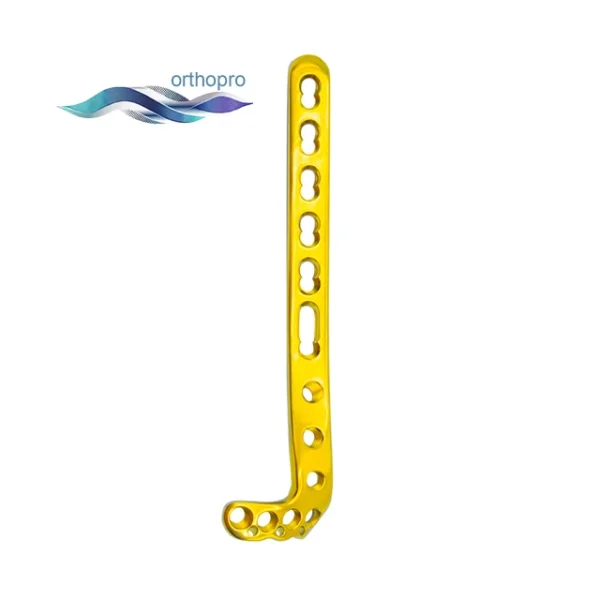
Anatomical Proximal Lateral Tibial Locking Plate II for Tibial Plateau Fracture Fixation | High-Strength Titanium Lateral Tibia LCP – OrthoPro
The Proximal Lateral Tibial Locking Plate II is a high-precision orthopedic implant designed for the stable internal fixation of complex proximal tibia fractures. This Proximal Lateral Tibial Locking Plate II offers a superior anatomical fit and fixed-angle stability, making our Proximal Lateral Tibia Locking Plate the preferred choice for surgeons treating tibial plateau injuries and metaphyseal trauma
Enter the PLTLP II: It’s All About the Curves
The PLTLP II vs I debate really centers on the anatomical design. Version II isn’t just a “better version”; it’s a “smarter fit.”
At OrthoPro, we’ve seen that the Version II plates are designed using vast databases of CT scans. They are pre-contoured. This means when the surgeon lays the plate on the lateral tibia, it “hugs” the bone.
Why the “Hugging” Fit Matters for B2B Buyers
If you’re a distributor, you want your surgeons to have an “Easy” button. If the plate fits perfectly without bending:
- Surgical time is reduced. (Hospitals love this; time is money).
- Blood supply is preserved. A well-fitting plate doesn’t need to be cinched down so hard that it crushes the periosteum (the bone’s “skin” that provides blood).
- Soft tissue irritation drops. This is the big one. The Version II has a lower profile.
I once worked with a distributor who kept getting complaints about “plate prominence.” Patients could feel the metal through their skin. We switched their stock to the Proximal Lateral Tibial Locking Plate II and those complaints vanished. That’s the OrthoPro brand value in action—solving problems before they become returns.
Technical Breakdown: PLTLP II vs I
Let’s look at the actual specs. If you’re sourcing, you need to know the numbers.
| Feature | PLTLP Version I | PLTLP Version II (The New Standard) |
| Anatomical Fit | Basic/Flat (Requires Bending) | High-Precision Pre-contoured |
| Profile Height | 3.5mm – 4.2mm (Relatively Thick) | 2.5mm – 3.5mm (Low Profile) |
| Screw Angulation | Fixed Parallel | Multi-directional / Divergent Raft |
| Material | Standard Titanium / SS | Ti-6Al-4V ELI (Grade 23) |
| MIPO Compatible | Difficult | Optimized for Percutaneous Entry |
| Soft Tissue Irritation | Common at the head | Minimized due to tapered edges |
The “Rafting” Effect: A Game Changer
One of the biggest version differences is how the screws are positioned in the head of the plate. In Version I, the screws were often just lined up. In the II, we use a “rafting” configuration.
Imagine you’re trying to support a collapsing ceiling. Would you put four pillars in a straight line, or would you spread them out in a grid? The grid—or raft—is much stronger.
The load-bearing capacity (L) of a raft of screws can be simplified as:
L = Sum of (S_i * A_i)
Where S_i is the shear strength of each screw and A_i is the cross-sectional area.
By diverging the screws in the PLTLP II, we cover more surface area of the subchondral bone. This is huge for Schatzker II or III fractures where the bone has basically “sunken” in. The II holds it up; the I often lets it slip. If you’re a medical device supplier China, offering the II shows you actually understand the clinical needs of the surgeon, not just the price point of the buyer.
Sourcing Realities: Why Some Still Buy Version I
I’ll be controversial here: Version I isn’t dead. Why? Because it’s cheaper. In some markets where the tender is strictly about the lowest possible price and the surgeons are used to “making it work,” the Version I still moves.
But here’s the risk for you as a B2B partner. The global trend is moving toward “Value-Based Healthcare.” If a hospital realizes that using a cheaper Version I plate leads to a 5% higher revision rate, they’ll drop that supplier in a heartbeat.
When you choose OrthoPro, you’re betting on the long game. The OrthoPro brand value isn’t about being the cheapest on the planet; it’s about being the most reliable in the OR. I’ve seen guys lose huge contracts because they saved $10 on a plate but the locking threads failed during a critical case. It’s just not worth the stress.
Manufacturing Precision in China
Let’s talk about the “Made in China” elephant. Some of the best orthopedic implant sourcing happens in specialized hubs in China now. But the gap between a “garage shop” and a high-end facility like ours is massive.
For a PLTLP II, the CNC programming is way more complex. You’re dealing with 5-axis milling to get those anatomical curves right.