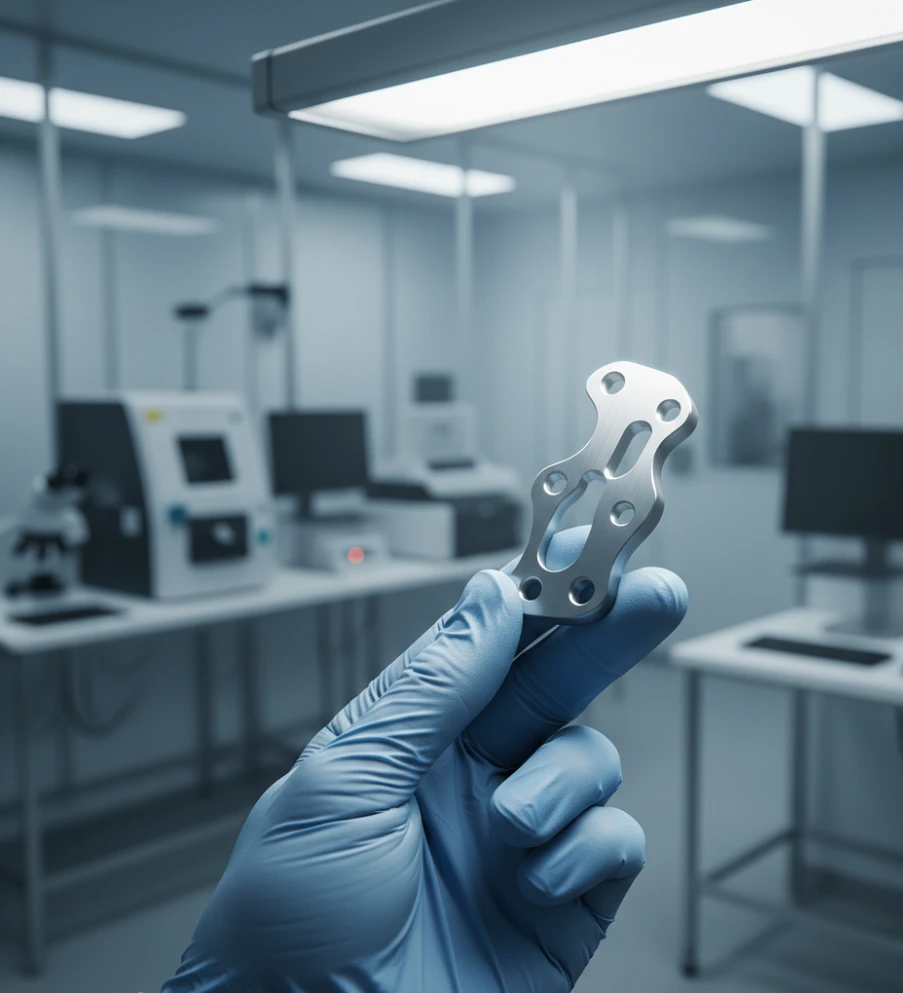
Look, I’ve been in the orthopedic sourcing game long enough to know the nightmare scenario. You get a shipment of trauma implants, they look shiny and perfect in the packaging, but the moment a surgeon tries to contour one in the O.R., it snaps. Or worse, the screw heads strip because the machining tolerance was off by a hair.
If you are a procurement manager or a distributor, you know that buying a Titanium Calcaneal Plate isn’t like buying office supplies. You’re buying someone’s ability to walk again.
The market is flooded with manufacturers claiming they have the best “aerospace-grade” titanium. But how do you actually verify that without flying to the factory with a mass spectrometer in your backpack?
Today, I’m going to walk you through exactly how to source these specific implants—specifically the H-Locking plates for calcaneal fractures. We’re going to get technical, we’re going to look at the math, and we’re going to cut through the marketing fluff.
Why the “H” Shape Matters (It’s Not Just Aesthetics)
First, let’s talk about geometry. The calcaneus (heel bone) is a weirdly shaped bone. It’s got a thin cortical shell and soft, cancellous bone inside. When it smashes (usually from a fall from height), it explodes like a watermelon.
The H-Locking Plate is the gold standard here because it allows for a “low profile” fit while grabbing multiple fragments.
The Low-Profile Requirement
The skin around the heel is notoriously thin. There is almost no fat or muscle to hide hardware. If you buy bulky plates from a Trauma Implant Manufacturer who hasn’t optimized the thickness, the patient gets wound necrosis. Period.
You need to look for plates with a thickness profile between 1.5mm and 2.0mm. Anything thicker is risky for the soft tissue; anything thinner might fail under load.
The Metal: Why “Titanium” Isn’t Enough
If a supplier just tells you their plates are “Titanium,” hang up the phone. That’s like a car dealer saying a car is made of “metal.”
For trauma implants, specifically locking plates, we are looking for Ti-6Al-4V ELI (Grade 23).
What is Ti-6Al-4V ELI?
This is the workhorse of the orthopedic industry.
- Ti: Titanium (The base)
- 6Al: 6% Aluminium (Stabilizes the Alpha phase, increases strength)
- 4V: 4% Vanadium (Stabilizes the Beta phase, allows for easier working)
- ELI: Extra Low Interstitials (This is the kicker).
Why ELI?
Standard Grade 5 titanium has higher oxygen and iron content. That makes it brittle. ELI reduces oxygen to 0.13% max and Iron to 0.25% max. This increases ductility.
Here is a quick check you can do on the spec sheet. If the elongation at break isn’t matching these numbers, it’s not genuine ELI:
Elongation Formula (Approximate representation):
Elongation % = ((Final Length – Original Length) / Original Length) * 100
For a high-quality calcaneal plate, you want to see an elongation percentage of > 10%. If it’s lower, the plate will snap when the surgeon tries to bend it to fit the patient’s heel.
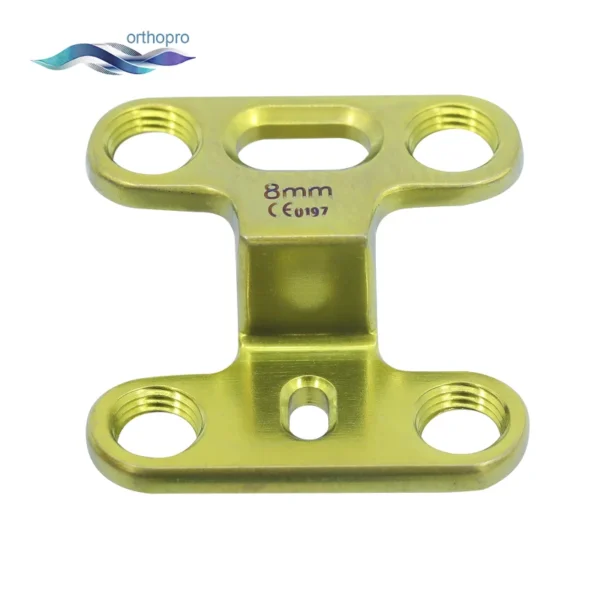
Calcaneal H Locking Plate (3.5mm System) | Minimally Invasive Titanium Heel Fracture Implant
The Calcaneal H Locking Plate is a specialized low-profile implant designed for the minimally invasive sinus tarsi approach to treat complex heel fractures. Compatible with 3.5mm locking screws, this Calcaneal H Locking Plate provides robust stability for comminuted fractures while reducing soft tissue complications. Our H-shaped calcaneal plate ensures anatomical fit and optimal restoration of Bohler’s angle.
Judging the Locking Mechanism (The Screw-Plate Interface)
This is where cheap manufacturing reveals itself. The Calcaneal H-Locking Plate usually uses 3.5mm locking screws.
The “Locking” part means the screw head has threads that mate with the plate hole threads. This creates a fixed-angle construct. It turns the plate and screws into a single rigid frame, which is vital for that mushy heel bone I mentioned earlier.
The Common Flaw:
If the Orthopedic Implant Supplier uses worn-out CNC bits, the threads in the plate hole will be slightly shallow. The screw goes in, feels tight, but under cyclical loading (walking), it creates “cold welding” or creates micro-motion that loosens the hardware.
We verify this at OrthoPro using “Go/No-Go” gauges on every single batch. When you are sourcing, ask your supplier for their Quality Control (QC) reports specifically regarding thread tolerance.
Visual Inspection Checklist for Buyers
You just received a sample. Don’t just look at it. Inspect it.
- Burrs: Run a cotton ball over the edges and the screw holes. If it snags, there are burrs. Burrs tear soft tissue and cause inflammation.
- Anodization: Is the color uniform? Anodization isn’t just for looking cool; it increases fatigue strength and helps identifying sizes. Type II anodization is what you want.
- The Countersink: Does the screw sit flush with the plate? In the heel, a screw head sticking up by even 0.5mm can cause severe pain.

(Alt Text: Microscope view of Ti-6Al-4V ELI titanium plate threads showing high precision machining)
Technical Specs: The Numbers You Need to Know
I put together this table so you can compare what a generic “cheap” plate looks like versus what a professional medical-grade plate should be.
| Feature | Low-End Supplier | High-Quality Supplier (e.g., OrthoPro) | Why it matters |
| Material | Titanium Grade 2 or Generic Grade 5 | Ti-6Al-4V ELI (ASTM F136) | Ductility prevents snapping during contouring. |
| Machining | 3-Axis CNC | 5-Axis Swiss Lathe / CNC | Complex geometry requires 5-axis for the H-shape curves. |
| Surface | Bead Blasted (Rough) | Electropolished & Anodized | Smoother surface reduces bacterial adhesion. |
| Tolerance | +/- 0.1mm | +/- 0.02mm | Ensures the locking screw actually locks. |
| Certifications | “Factory Certified” | ISO 13485:2016 | Ensures traceability from raw bar stock to packaging. |
The ISO 13485 Orthopedic Standard
You see “ISO Certified” on websites all the time. But for us, ISO 13485 is the only one that counts. It’s specific to medical devices.
What to ask for:
Don’t just ask “Are you certified?” Ask for the audit report summary. A real manufacturer like OrthoPro will have traceability logs.
This means if I hold a plate in my hand, I can tell you exactly which batch of titanium bar stock it came from, who mined the metal, and which machinist ran the machine that day.
If your supplier can’t give you that “upstream traceability,” you are taking a massive liability risk.
A “Real World” Sourcing Story
I want to share a quick story (names changed for privacy).
We had a client in Mexico, let’s call him Eduardo. Eduardo was buying trauma implants from a generic factory in East Asia. The price was great—about 40% cheaper than the European standard.
Things were fine for six months. Then, surgeons started complaining that the 3.5mm screws were “stripping” the heads when they applied torque. The driver wouldn’t grip.
Eduardo lost two major hospital contracts in one month.
Why did it happen? The supplier had switched to a cheaper steel for their screwdriver bits and slightly softer titanium for the screws to save on tool wear.
Eduardo switched to us at OrthoPro. We aren’t the cheapest on the planet, but our screws don’t strip. He won those contracts back because the surgeons trusted the gear again.
The Lesson: The cost of a failed surgery is 100x the cost of the implant.
Questions to Grill Your Supplier With
When you are on that Zoom call with a potential Orthopedic Implant Supplier, ask them these uncomfortable questions:
- “Can you provide the Mill Test Certificate (MTC) for the raw titanium before I place the order?”
- “What is your cleaning validation process? Do you use ultrasonic cleaning with passivation?”
- “If a screw strips during surgery, what is your RMA (Return Merchandise Authorization) process?”
A good supplier will answer these instantly. A middleman will say, “I’ll get back to you.”
Sourcing Logistics: Getting it to Your Warehouse
It’s not just about the metal. It’s about the box.
Orthopedic plates are often shipped non-sterile (to be sterilized at the hospital) or sterile.
If you are importing, ensure the packaging is double-barrier. We use heavy-duty pouches because customs inspectors are rough. I’ve seen shipments arrive where the plates poked through the plastic because the packaging was too thin. That renders the whole batch “contaminated” in the eyes of a hospital.
Also, check the HS Codes. For orthopedic implants, it’s usually 9021.10. Getting this wrong can get your shipment stuck in customs for weeks.
Conclusion: Don’t Compromise on the Heel
The calcaneus carries the entire weight of the body. The hardware you put in there has to be flawless.
Choosing a Titanium Calcaneal Plate isn’t just about comparing price sheets. It’s about understanding the metallurgy, the machining tolerance, and the integrity of the supplier.
At OrthoPro, we specialize in high-grade trauma implants. We use Ti-6Al-4V ELI because we know that surgeons need to bend plates without fear of breakage. We adhere to ISO 13485 Orthopedic standards because we know traceability protects everyone.
Ready to upgrade your inventory?
If you are tired of inconsistent quality or suppliers who ghost you when things go wrong, let’s talk.
- Check out our standards: Visit OrthoPro
- Need a quote? Drop us a line at Contact Us or email me directly at info@orthopro.mx.
Don’t risk your reputation on bad metal. Get the good stuff.
FAQ
1. What is the difference between Locking and Non-Locking Calcaneal plates?
A non-locking plate relies on the screw compressing the plate against the bone to hold it in place (friction). A locking plate has threads on the screw head that lock into the plate. For calcaneal fractures, locking plates are superior because the heel bone is often soft (osteopenic), and normal screws can pull out. The locking mechanism creates a “bridge” that supports the bone without needing perfect bone quality.
2. Can I autoclave OrthoPro Titanium plates?
Yes, absolutely. Our Ti-6Al-4V ELI plates are designed to withstand repeated autoclave cycles. However, we always recommend following the hospital’s specific sterilization protocol (usually 132°C – 134°C for specific durations). Ensure the plates are cleaned properly prior to sterilization if they were handled.
3. Why is Ti-6Al-4V ELI better than Stainless Steel for Calcaneal plates?
Two main reasons: Modulus of Elasticity and Bio-compatibility. Titanium’s elasticity is closer to human bone than stainless steel. This reduces “stress shielding” (where the bone gets weak because the plate takes all the load). Also, Titanium is non-ferromagnetic, meaning the patient can safely get an MRI scan in the future without the plate heating up or moving.