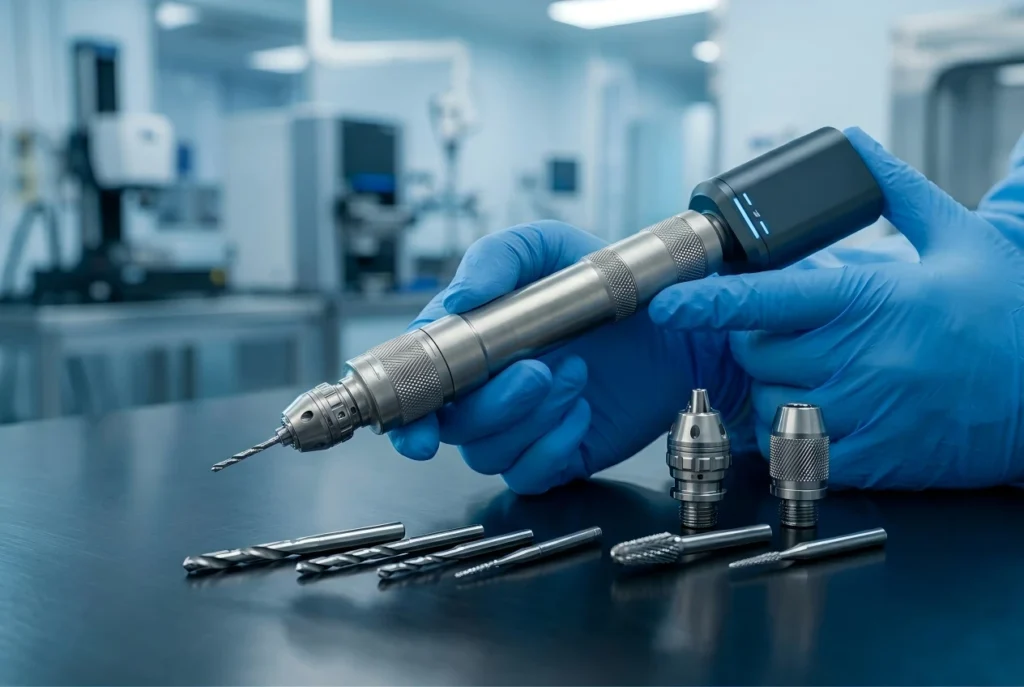
Look. If you’ve been in the B2B medical devices game long enough, you already know the cold, hard truth. Sourcing orthopedic power tools isn’t about browsing a shiny catalog and hitting “add to cart.” It’s a battlefield.
You find a surgical drill supplier online, the specs look decent, the price is tempting. You bring in a batch, sell them to a local hospital network, and then the nightmare starts. Batteries dying mid-surgery. Chucks jamming up during a critical femur fixation. The hospital’s procurement director is screaming at you on a Tuesday morning, and the overseas factory suddenly stops replying to your emails.
I’ve been there. I’ve seen medical distributors lose million-dollar hospital contracts because they trusted the wrong manufacturer.
Today, we’re cutting through the marketing fluff. I’m going to walk you through exactly how to source reliable, multi-functional orthopedic power tools. No corporate jargon. Just the raw, technical reality of what you need to look for, how to sniff out a bad factory, and how to protect your margins.
The “Big Brand” Illusion (And Why It Costs You Money)
Let’s start with a controversial take that alot of folks in the industry don’t want to hear. The mega-brands in the orthopedic space—you know the ones—they make great stuff. But are you paying for ground-breaking innovation on every standard bone drill? No. You’re mostly paying for the logo stamped on the handpiece.
To be honst, a massive chunk of components for these high-end drills are manufactured in the same industrial hubs that supply independent OEM/ODM factories. The motor technology, the medical-grade stainless steel, the battery cells—these aren’t proprietary magic.
Hospitals are waking up to this. With healthcare budgets tightening globally, surgeons and procurement teams want equipment that works flawlessly without the 300% markup. This is the golden opportunity for smart medical distributors. If you can provide a wholesale orthopedic bone drill that matches the big guys in torque, battery life, and sterilization durability, you win the contract. Period.
Deep Dive: Tech Specs You Actually Need to Care About
When you’re auditing a new surgical drill supplier, you need to look past the basic brochure. Here is the technical grit you need to verify before you sign a purchase order.
1. The Motor: Brushless is Non-Negotiable
If a supplier is trying to sell you a drill with a brushed motor in 2026, run away. Brushed motors use carbon brushes that wear down. They create friction, which creates heat. In a sterile OR environment, the last thing a surgeon needs is a handpiece getting uncomfortably hot during a long joint replacement.
You want coreless brushless motors. They offer precise speed control, zero carbon dust, and massively reduced noise levels (anything over 65dB is going to annoy the surgical team).
When evaluating a drill’s performance, remember the basic physics behind bone milling:
Power (Watts) = Torque (Nm) x Angular Velocity (Rad/s)
For a multi-functional system, you need a motor that can handle both high-speed drilling (typically around 1000-1200 RPM) and low-speed, high-torque reaming (around 200-300 RPM). If the motor lacks the torque, the drill will stall the moment the surgeon hits dense cortical bone.
2. The Battery: Sterilization Realities
This is where 70% of overseas drills fail. The battery.
Ni-MH batteries are old news. They suffer from the “memory effect” and degrade fast. You need Lithium-ion (Li-ion) power blocks.
But here’s the catch—Li-ion batteries hate high temperatures. Yet, the entire drill system needs to be autoclavable. The industry standard for sterilization is 135 degrees Celsius at 1.6 MPa of pressure for roughly 20 minutes.
How does a good manufacturer solve this? They build non-sterilizable battery packs that are inserted into a fully sterile housing using a sterile transfer funnel. If your supplier’s battery casing doesn’t have a flawless sealing mechanism, moisture from the autoclave will destroy the internal circuits within a month. Ask the factory for their IP sealing rating and their failure rates after 500 autoclave cycles. If they hesitate, they’re hiding something.
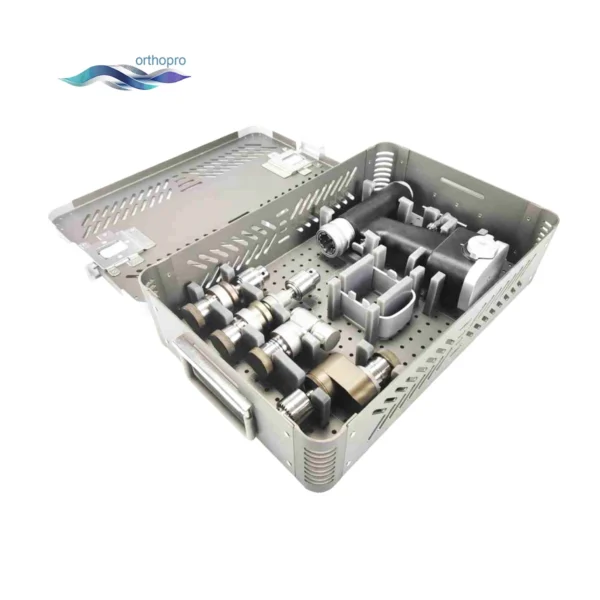
Multi-Functional Orthopedic Bone Drill System for Joint Surgery | OrthoPro
The OrthoPro Multi-Functional Orthopedic Bone Drill is a premium surgical power tool for precise bone drilling and cutting. This versatile orthopedic bone drill features a robust brushless motor. Ideal for B2B medical suppliers, our surgical bone drill ensures reliability in joint and trauma surgeries.
3. The “Multi-Functional” Aspect
A true multi-functional system is a game-changer for B2B medical devices. Instead of a hospital buying a seperate drill, oscillating saw, reciprocating saw, and K-wire driver, they buy one motorized handpiece with quick-release attachments.
Check the chucks. You want Jacobs chucks and AO quick-release chucks made from high-grade 17-4 stainless steel. Try attaching and detaching the saw heads. If there is even a millimeter of wobble or if it requires too much physical force to click into place, the machining tolerances at the factory are garbage.
The Math Behind Your Sourcing ROI
You aren’t buying these drills for charity. You’re a distributor. The math needs to make sense. Let’s look at how you should be calculating your true sourcing ROI, not just the sticker price.
Your real profit formula isn’t just (Selling Price – Factory Price). You have to calculate the Total Landed Cost and factor in the hidden cost of defective returns.
Distributor ROI (%) =[(Net Revenue – Total Landed Cost – Defect Penalty) / Total Landed Cost] x 100
- Total Landed Cost = FOB Factory Price + Ocean/Air Freight + Customs Duties + Warehousing/Insurance.
- Defect Penalty = The cost of replacing a broken drill + the reputational damage + shipping it back for warranty claims.
If you buy a dirt-cheap drill for $800 but 1 in 5 break down in the first year, your Defect Penalty destroys your margin. Sourcing a rock-solid unit from a reliable factory for $1,200 gives you peace of mind, happier surgeons, and a much higher lifetime ROI per hospital account.
Evaluating a Surgical Drill Supplier: Red Flags and Green Lights
I’ve audited dozens of medical device factories in my career. Some are state-of-the-art facilities; others are basically unventilated garages assembling parts they bought on Alibaba.
Here is a quick table to help you tell the difference during your vetting process.
| Evaluation Metric | The “Garage” Assembler (Red Flag) | A Real Manufacturer (Green Light) |
|---|---|---|
| Quality Certifications | Claims “CE” but can’t provide the valid Notified Body number. | Provides ISO 13485 and verifiable CE/FDA documentation immediately. |
| Supply Chain Transparency | Refuses to show you their CNC machining floor on a video call. | Proudly gives virtual or physical tours of their raw material processing. |
| Warranty & Spare Parts | “1 year warranty.” But takes 3 months to ship a replacement battery. | Stocks spare parts locally or guarantees 7-day DHL replacement shipping. |
| OEM/ODM Capability | Can only slap a sticker on a generic box. | Can laser-engrave your logo on the handpiece and customize chucks. |
| Technical Support | Sales rep doesn’t know the difference between oscillating and reciprocating. | Rep provides torque curves, battery cycle data, and sterilization protocols. |
Real Talk: A Sourcing Nightmare (And the Fix)
Let me share a story from a distributor based in Brazil. Let’s keep names out of it to protect the guilty.
This distributor landed a massive tender to supply regional trauma centers. They found a supplier online offering a multi-functional orthopedic drill at a price that seemed too good to pass up. They bought 50 units.
The first two weeks went fine. Then, during a critical tibial nailing procedure, the cannulated drill bit got stuck. The quick-release mechanism jammed because the internal springs were made of cheap, non-surgical steel that rusted after just three trips through the hospital’s autoclave.
The hospital suspended the distributor. The distributor called the supplier, only to find out the “factory” was actually a trading company. They had sourced the handpieces from one factory, the batteries from another, and the attachments from a third. None of the tolerances matched. It was a Frankenstein drill.
How did they fix it? They stopped chasing the absolute bottom dollar. They flew to a proper manufacturing facility, audited the CNC machines, checked the raw titanium and stainless steel invoices, and established a direct OEM relationship.
The lesson? You are risking your entire business reputation on the tools you supply. Don’t gamble it on a middleman.
OEM and ODM Customization: Building Your Own Brand Equity
One of the biggest advantages of working with a direct surgical drill supplier like OrthoPro is the ability to build your own brand.
Why spend years pushing someone else’s name in your home market when you can build equity in your own?
A solid manufacturer offers extensive OEM (Original Equipment Manufacturer) and ODM (Original Design Manufacturer) services. This means you can get your company logo laser-etched directly onto the surgical handpiece and the sterilization case.
But it goes deeper than logos. Depending on your market’s specific needs, a real factory can customize the RPM settings. Maybe the surgeons in your region prefer a slightly heavier, more robust handpiece for veterinary orthopedics, or maybe they want an ultra-lightweight design for delicate hand and wrist procedures.
When you control the brand, you control the pricing. You aren’t competing with three other distributors selling the exact same branded drill in your city. You own the market.
How Supply Chain Disruptions Mess With Your Stock
We can’t talk about B2B medical devices without talking about the chaotic global supply chain.
You need a supplier who actually stocks raw materials. When there’s a global shortage of surgical-grade stainless steel or a delay in microchip manufacturing for the motor controllers, the weak factories shut down production. They tell you your lead time just went from 30 days to 120 days.
You can’t tell a hospital that their trauma ward has to wait four months for power tools.
When interviewing a potential partner, ask them about their inventory buffers. How much raw material do they keep on hand? What is their standard turnaround time for a bulk order of 100 units? If they say they only buy raw materials after you place a deposit, you are absorbing all of their supply chain risk.
At OrthoPro, we understand that our distributors need predictable, boring supply chains. Predictable means you get your gear on time. Boring means you sleep well at night knowing your hospitals are fully equipped.
Wrapping Up the Tech Specs: The Anatomy of a Perfect Drill
Let’s summarize what a flawless multi-functional drill looks like on paper so you have a checklist for your next procurement meeting:
- Handpiece Material: Anodized aluminum or surgical stainless steel (must survive aggressive chemical cleaning).
- Motor: Coreless brushless, minimum 100W output, zero maintenance.
- Speed Control: Stepless trigger. The harder you pull, the faster it spins. No jerky movements.
- Cannulation: Usually around 4.2mm to accomodate standard K-wires and guide pins.
- Noise Level: Under 65 decibels.
- Attachments: Jacobs drill chuck, AO quick coupling, Oscillating saw (min 14,000 CPM), Reciprocating saw, Reamer (high torque).
- Battery: 14.4V or higher Li-ion, minimum 2-hour continuous runtime under load.
If your current supplier falls short on even one of these, you are leaving yourself vulnerable to hospital complaints.
FAQ
You probably still have some practical questions. Here are the most common things medical distributors ask me when they’re looking to switch suppliers.
Q1: Is it really safe to autoclave the handpiece of a battery-operated drill?
Yes, absolutely—if it’s built right. The internal electronics and the brushless motor of a high-quality orthopedic drill are hermetically sealed. You must remove the non-sterile battery pack before putting the handpiece and attachments into the autoclave. The standard protocol is 135°C high-pressure steam. Never autoclave the battery itself; use the aseptic transfer method.
Q2: What is the typical lead time for a wholesale order of multi-functional drills?
For a reliable factory, standard non-customized wholesale orders usually take about 15 to 25 working days to manufacture and test. If you are requesting OEM services like laser engraving or custom packaging, expect to add another 7 to 10 days to the initial order. Always factor in ocean or air freight times to your specific country.
Q3: How do I handle warranty repairs if the manufacturer is overseas?
A good surgical drill supplier doesn’t make you ship an entire drill back across the world for a minor issue. They should provide you with a detailed troubleshooting guide and video support. If a specific component fails (like a circuit board or a chuck), they should DHL the replacement part directly to you within days. Make sure you negotiate this spare-parts clause before signing the contract.
Q4: Can I buy just the handpiece if my hospitals already have attachments?
Usually, yes, but it’s risky. Chucks and coupling mechanisms from different brands aren’t always 100% compatible, even if they claim to follow standard AO connections. Micro-wobbles can occur. It’s almost always better to source the handpiece and the attachments as a complete calibrated set to ensure surgical precision.
Let’s Fix Your Sourcing Headaches
Stop rolling the dice on unverified suppliers. You’ve worked too hard to build your distribution network to let a bad batch of power tools ruin your relationship with key surgeons.
You need equipment that works flawlessly, margins that make sense, and a factory partner that actually picks up the phone when you have a technical question.
That’s exactly what we do. We engineer rock-solid, multi-functional bone drills designed to take a beating in the OR and keep running. We handle the OEM branding, the stringent QC testing, and the global logistics. You handle closing the deals in your local market.
Tired of dealing with middlemen and dropped shipments? Let’s talk directly.
Head over to our contact page right now. Tell us what market you are operating in and what volume you’re looking for. Or, if you hate forms, just shoot an email straight to our team at info@orthopro.mx.
Let’s get your hospital clients the gear they deserve, and get your profit margins back where they belong.