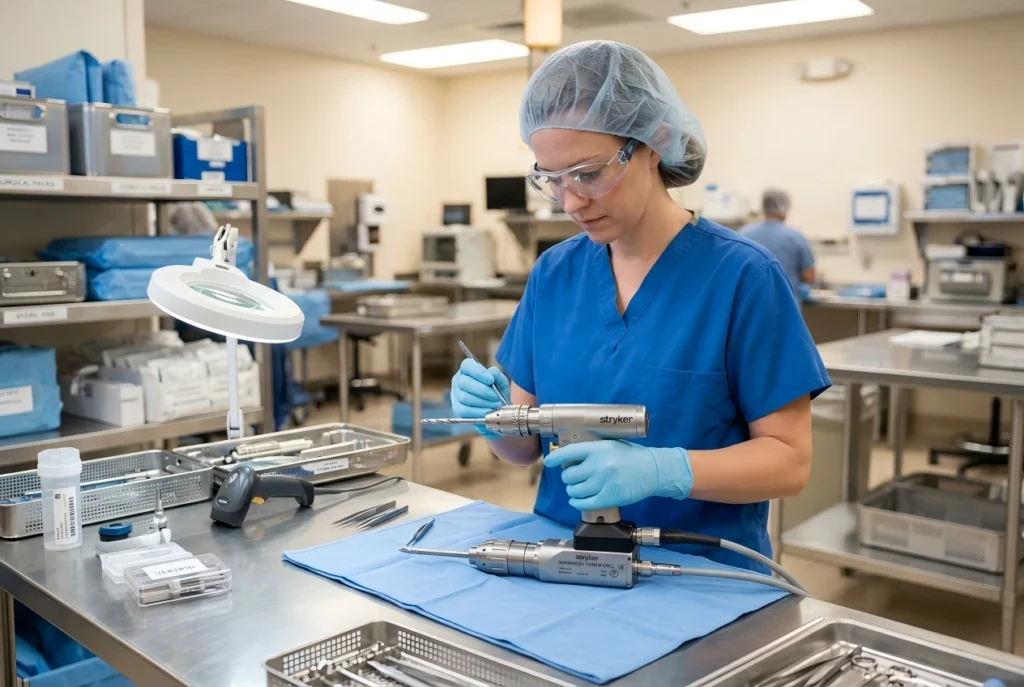
Walk into any hospital’s sterile processing department around 3 PM, and you’ll see a chaotic mess of blood, bone dust, and frustrated techs. I’ve spent years working with medical device distributors and hospital biomedical engineers, and the number one complaint I hear across the board is always the same: “Why did this $6,000 drill die after only six months?”
The truth is usually something nobody wants to admit. The drill didn’t just die. It was murdered.
Heat, moisture, and terrible cleaning habits are destroying hospital budgets. When you are supplying equipment to hospitals, or if you are the person in charge of keeping that equipment running, you need a reality check on how surgical instrument care actually happens in the real world. OEM manuals are often written by lawyers trying to avoid liability, filled with hundred-step cleaning processes that a busy hospital tech simply doesn’t have the time to follow.
So, I’m going to give it to you straight. We are going to look at what actually works for orthopedic power tools maintenance, how to properly sterilize surgical drills without frying the internals, and why investing in a true autoclavable medical saw from a reliable manufacturer like OrthoPro is the only way to stop the endless cycle of repairs.
The Saline Disaster (And Other Point-of-Use Nightmares)
Let’s start with a controversial opinion: Operating room nurses are often the biggest threat to your equipment’s lifespan.
I know, that sounds harsh. But hear me out. During an orthopedic procedure, a surgeon puts down a drill. It’s covered in tissue and blood. The scrub nurse wants to keep it from drying out, which is good. But instead of using a sterile water sponge, they wipe it down with sterile saline.
This happens all the time. It is a massive mistake.
Saline contains sodium chloride. Chloride ions are the natural enemy of stainless steel and anodized aluminum. If saline sits on a surgical drill, it initiates pitting corrosion. It creates microscopic craters in the metal, which eventually compromise the watertight seals around the drive shafts and triggers. Once those seals are compromised, your next trip to the autoclave will force high-pressure steam straight into the motor housing.
If you are a distributor educating your end-users, make this your golden rule: Never use saline to wipe down power tools. Always use sterile water.
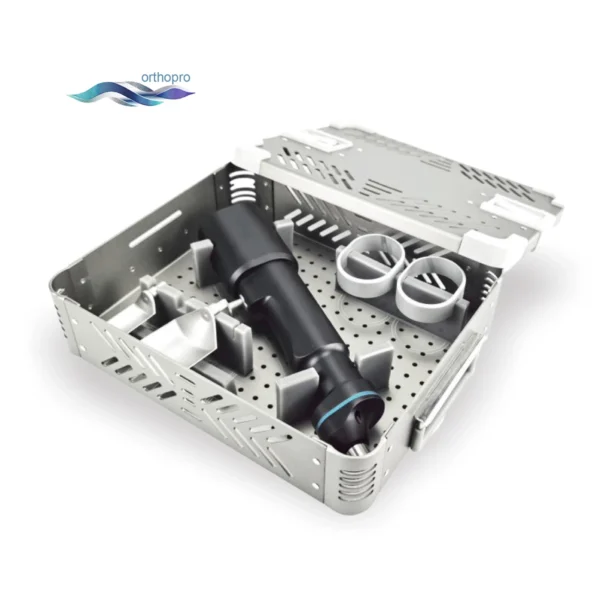
Premium Orthopedic Implants Drill Sterilization Box | Surgical Power Tool Autoclave Case B2B Wholesale
The Orthopedic Implants Drill Sterilization Box is designed to securely hold and sterilize surgical power tools. This durable Orthopedic Implants Drill Sterilization Box ensures complete instrument asepsis and prevents intraoperative malfunctions. Built for medical B2B distributors and hospitals globally, it guarantees optimal protection for your high-precision surgical drills during high-temperature autoclaving.
Anatomy of a Survivor: What Makes an Autoclavable Medical Saw Actually Autoclavable?
Hospital equipment managers constantly ask me if a product is “autoclavable.” It’s a binary question, but the reality is a spectrum. Just because a label says it can go in an autoclave doesn’t mean it will survive 500 cycles.
When you look at high-end medical power tools, the engineering inside is what determines the attrition rate.
Here is what you actually need to look for:
- Brushless DC Motors: Old brushed motors create carbon dust as they run. When you introduce steam to carbon dust, it creates a conductive sludge that eventually shorts out the stator. A true autoclavable medical saw uses hermetically sealed brushless motors.
- PEEK Components: Polyether ether ketone (PEEK) is a ridiculously tough plastic that doesn’t degrade under 134°C steam. Cheap tools use standard ABS or polycarbonate blends that get brittle and crack after 50 cycles.
- Dynamic Seals: A stationary seal is easy. A seal that keeps steam out while a drill bit is spinning at 1,200 RPM is hard. High-quality tools use advanced fluoroelastomer (FKM) lip seals that expand predictably under heat.
If the hospital’s purchasing department bought cheap knockoffs to save a few bucks upfront, their maintance costs are going to skyrocket when those internal seals fail.
Step-by-Step Orthopedic Power Tools Maintenance (The Real World Version)
Forget the 80-page manual for a second. If you want your end-customers to stop shipping broken handpieces back to you, teach them this streamlined, realistic protocol.
1. The Pre-Clean (Within 30 Minutes)
Bioburden (blood, fat, bone) hardens like cement if left to dry. The tool needs to be wiped down with a damp (sterile water!) cloth immediately after the procedure. If the tool has cannulations (hollow channels for K-wires), run a proper sized brush through it right there in the OR.
2. Manual Decontamination
Most orthopedic power tools are not submersible. I’ll repeat that because someone always gets it wrong: Do not throw the drill into a sink full of soapy water.
Use an enzymatic cleaner. Enzymes break down proteins and lipids. Apply it with a soft brush, keeping the nose of the handpiece pointed downward so liquid doesn’t run back into the trigger mechanism. Rinse it by wiping it with a clean, damp cloth.
3. The Lubrication Lie
Here is another thing that drives me crazy. Techs love to drown instruments in lubricant spray. They think “more is better.”
When you flood a handpiece with generic mineral oil and then put it in an autoclave, that oil bakes. It turns into a sticky, brown varnish. Over time, this varnish builds up on the internal bearings until the motor has to work twice as hard to spin, leading to overheating and premature failure.
Only use the exact synthetic lubricant specified for surgical instrument care, and only put a single drop on the moving parts (like the chuck and the attachments). Run the tool for 5 seconds to distribute the oil, then wipe off any excess.
4. Packaging and Loading
Don’t just toss the drill into a sterilization tray with 40 pounds of retractors and mallets. Power tools need their own dedicated sterilization cases with silicone mats to absorb vibrations and protect the housing. Leave heavy items in a seperate tray.
How to Sterilize Surgical Drills: The Science of Steam
Let’s get a bit technical because understanding the physics of the autoclave is the only way to stop abusing the equipment.
Sterilization isn’t just getting things hot; it’s a specific calculation of time, temperature, and pressure. The accepted standard for steam sterilization is outlined by AAMI (Association for the Advancement of Medical Instrumentation) ST79 guidelines.
Most hospitals use pre-vacuum (dynamic air removal) sterilizers. The standard cycle for wrapped orthopedic power tools is 132°C (270°F) for 4 minutes of exposure time, followed by a minimum of 20 to 30 minutes of dry time.
If you want to know how biomedical engineers actually calculate lethality (the bug-killing power of a cycle), we use something called the F0 (F-zero) value. Since we can’t use complex math formatting here, I’ll write the formula out simply:
F0 = dt * 10^[(T – 121) / z]
Here is what that actually means:
- F0 is the equivalent exposure time at 121°C.
- dt is the time interval.
- T is the actual temperature in the autoclave.
- z is a constant for the specific bacteria you are trying to kill (usually 10°C for Geobacillus stearothermophilus spores).
Basically, for every degree above 121°C, the killing power goes up exponentially. That’s why a 132°C cycle only takes 4 minutes instead of 30. But that extreme heat is violent on the tool’s electronics and batteries.
The Battery Nightmare
Speaking of batteries… they are the weakest link in any orthopedic power tools maintenance program.
Lithium-ion cells degrade rapidly when exposed to high temperatures. If a hospital complains that their batteries aren’t holding a charge, ask them about their cooling protocol.
When a battery comes out of the autoclave, it is baking hot. I have actually seen techs throw hot batteries into a fridge or wrap them in wet towels to cool them down faster for the next surgery. This is a massive mistake. Rapid cooling causes the metal casing to contract faster than the internal cells, and it pulls humid room air past the seals, creating condensation right on the motherboard.
Batteries must cool naturally on a wire rack at room temperature for at least an hour. Yes, this means the hospital needs to buy more backup batteries to cover their case volume. Tell them to stop being cheap and buy the extra inventory, or they will be replacing dead batteries every three months.
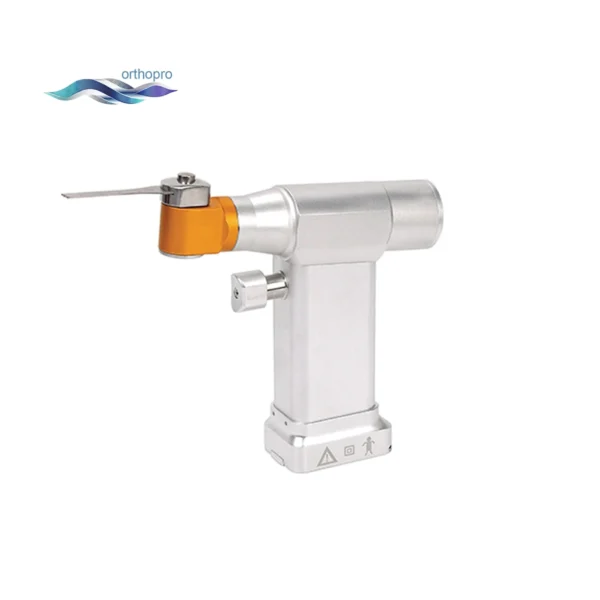
Premium Orthopedic Small Oscillating Saw for Hand and Foot Surgery | OrthoPro
The OrthoPro orthopedic small oscillating saw is a high-precision surgical power tool engineered for hand, foot, and veterinary osteotomy. This orthopedic small oscillating saw ensures exact cuts with minimal tissue damage. Choose our small oscillating saw for reliable, autoclavable performance.
My Beef with Flash Sterilization (IUSS)
I absolutely hate Immediate-Use Steam Sterilization (IUSS), commonly known as flash sterilization.
Hospitals use this when they drop a tool on the floor and need it back right away, or more commonly, because they don’t own enough equipment to handle their daily caseload. Flash sterilization skips the drying cycle.
When you skip the dry time, the tool comes out wet. The internal motor stays wet. You then hand a wet, 132-degree drill to a surgeon who immediately starts drilling into a dense femur. The thermal shock combined with the trapped moisture boils the internal lubrication right out of the bearings. Doing this regularly will cut the lifespan of a $10,000 trauma drill in half. Just don’t do it.
Real World Case Study: The Distributor Who Fixed the Problem
Let me share a quick story. Last year, a regional distributor down in Mexico was dealing with a nightmare. They had supplied a major trauma center with 15 sets of orthopedic power tools. Within 8 months, the hospital was threatening to cancel their contract because 6 of the drills had “failed.”
The distributor reached out for advice. We did an audit of the hospital’s SPD.
Guess what we found?
- They were soaking the handpieces in highly alkaline detergents (pH > 10), which was eating the anodized coating.
- They were skipping the dry time on the autoclave to rush tools up to the OR.
- They were using generic hardware store WD-40 to lubricate the chucks. (I wish I was making that up).
We completely overhauled their surgical instrument care protocol. We switched them to a neutral pH enzymatic cleaner. We instituted a hard rule: no IUSS cycles for power tools. And we supplied them with proper autoclavable medical saws engineered for high-volume use.
The result? In the next 14 months, they had zero tool failures. Not a single one.
The Cost of Ignoring Maintenance
To make it incredibly clear for any hospital administrators reading this, let’s look at the numbers. Here is a rough breakdown of what happens over 3 years with a standard orthopedic trauma kit if you ignore proper protocols versus if you follow them.
| Metric | Bad Habits (Rushing, Poor Lube, Saline) | Proper Orthopedic Power Tools Maintenance |
|---|---|---|
| Average Tool Lifespan | 12 – 18 months | 48 – 60+ months |
| Annual Repair Costs | $3,500 – $5,000 | $500 (Basic PM & Calibration) |
| Battery Replacements (3 Yrs) | 6 per set | 2 per set |
| Surgery Delays | Frequent (due to dead tools) | Rare |
| Total 3-Year Cost per Kit | $25,000+ | Under $12,000 |
Numbers don’t lie. Properly maintaining your gear is quite literally a six-figure difference for a busy hospital over a few years.
Wrapping Your Head Around the Right Gear
At the end of the day, you can have the best orthopedic power tools maintenance protocols in the world, but if you start with garbage equipment, you will get garbage results.
Hospitals need equipment that is engineered defensively. They need tools that assume the tech might accidentally use the wrong cleaner once in a while. They need battery housings that can take a beating. If you are a distributor looking for OEM products that won’t destroy your reputation with constant warranty claims, you need to partner with manufacturers who understand these real-world SPD enviroments.
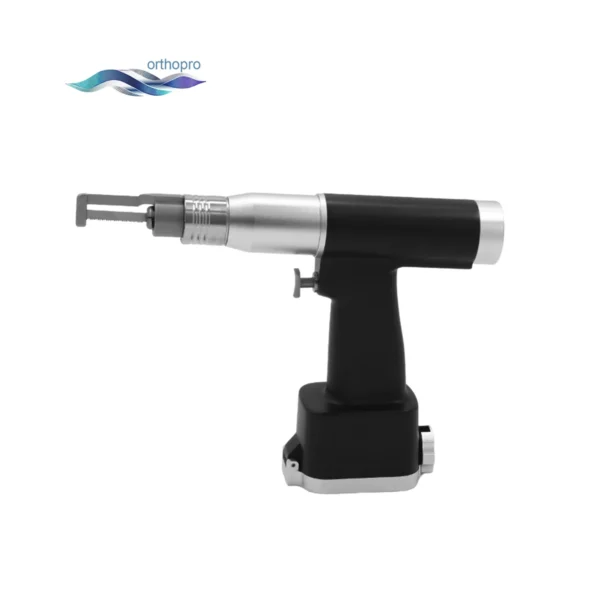
Premium Orthopedic Sternum Saw Instrument for Cardiothoracic & Bone Surgery – B2B Wholesale
The orthopedic sternum saw is a high-precision medical power tool for efficient bone cutting. This advanced orthopedic sternum saw ensures safe operations and minimizes soft tissue damage. Ideal for B2B wholesale, our surgical sternum saws feature brushless motors and ergonomic designs.
Frequently Asked Questions (FAQ)
Can we use washer-disinfectors for our power tools?
Only if the manufacturer explicitly states the tool is IPX8 rated and approved for automated washers. Most standard surgical drills are NOT. Putting a non-submersible drill in a washer-disinfector will blast high-pressure water past the seals and destroy the motor. Always manually clean unless the manual definetly says otherwise.
Why is the drill handle getting extremely hot during surgery?
If the handle is burning the surgeon’s glove, your internal bearings are likely shot, or the gear train is jammed with dried, baked-on bioburden. This happens when the tool wasn’t cleaned properly before sterilization, or it hasn’t been calibrated and lubricated. Send it in for a complete teardown and repair immediately before the motor burns out completely.
How often should we send tools in for preventative maintenance (PM)?
For a high-volume trauma center, you should be sending your handpieces in for professional OEM maintenance every 6 to 12 months. They will replace the dynamic seals (which wear out naturally from friction), check the torque output, and re-pack the internal greases that you can’t reach during daily cleaning.
Stop Burning Through Your Budget
Look, managing surgical equipment is tough. Distributors are tired of eating repair costs, and hospital techs are stressed out trying to keep up with the surgery schedule. But the cycle of breaking and replacing expensive tools doesn’t have to be your normal.
It starts with better habits, and it ends with better equipment. If you are a medical device distributor looking for rugged, reliable OEM products that can actually survive the brutal reality of hospital autoclaves, we need to talk.
At OrthoPro, we build tools designed for the real world. Stop settling for equipment that fails when you look at it wrong. Check out our full line of heavy-duty solutions and contact us today to get a quote or discuss how we can upgrade your current catalog.