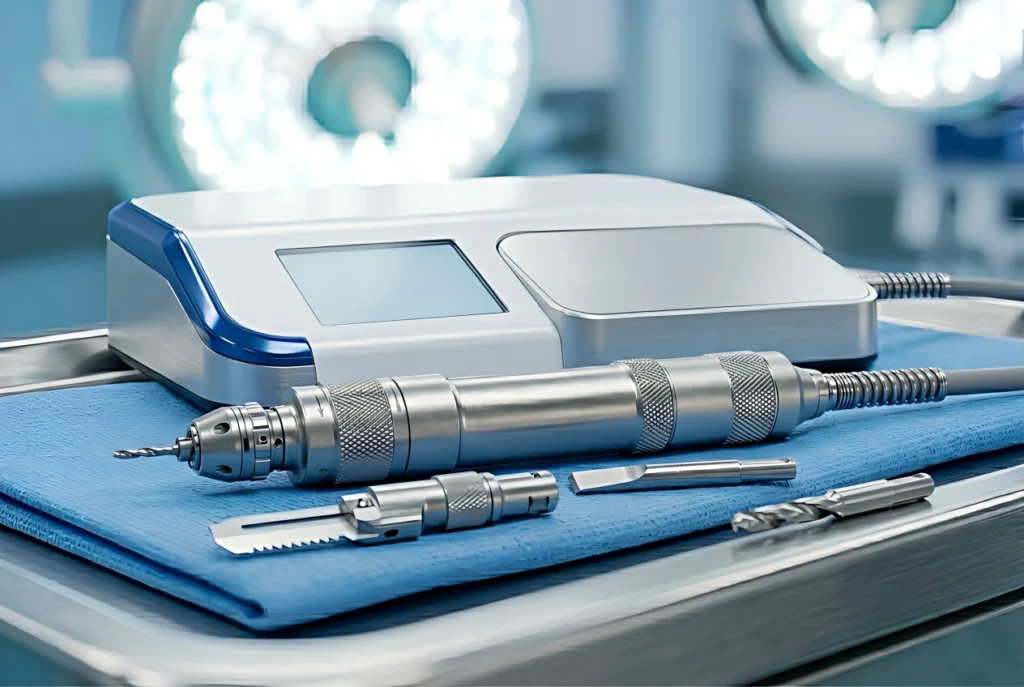
Look, anyone who works in hospital procurement knows the drill (pun intended). You’ve got the chief of orthopedics banging on your door demanding the latest, most expensive brand-name power tools, and on the other side, your CFO is sending passive-aggressive emails about slashing the departmental budget by 15%.
Bridging that massive gap is the hardest part of medical equipment sourcing. You can’t compromise on patient safety, but you also can’t bankrupt the facility buying single-use gadgets that sit in the sterile processing department half the time.
This is exactly why the shift towards modular, versatile equipment has taken over. Getting a reliable multi-functional orthopedic bone drill is probably the smartest financial and clinical move a hospital can make right now. But the market is absolutely flooded with options, and let’s be honest, a lot of the marketing brochures are just pure fluff.
I’m going to break down exactly what you need to look for when evaluating these systems. No sales jargon, just the raw specs, the hidden costs, and the harsh realities of what happens when a tool fails mid-surgery.
The Realities of Medical Equipment Sourcing in Orthopedics
Before we get into the nuts and bolts of torque and battery life, we need to address a controversial reality in hospital purchasing. A massive chunk of the price tag on “premium” Western brands is purely paying for the logo. I’ve seen hospitals bleed their capital budgets dry on big-name systems, only to find out the battery replacement costs are essentially extortion.
You need an orthopedic power tools buying guide that focuses on total cost of ownership (TCO) and clinical efficacy, not just brand prestige. When you buy a multi-functional system, you’re buying a single handpiece—a primary engine—that can adapt to drilling, reaming, sawing, and pinning simply by snapping on a different attachment.
This reduces the physical footprint in the operating room, drastically cuts down the workload for your sterile processing team, and keeps the finance department off your back. But if that main handpiece fails, the whole surgery stops. So the core unit has to be bulletproof.
The Engine Room: Torque, RPM, and the Math of Bone Resection
Surgeons will often complain that a tool “feels weak.” As a buyer, you need to translate that subjective complaint into objective specs. Usually, when a surgical bone drill bogs down, it’s not a lack of speed; it’s a lack of torque.
Orthopedic surgery deals with different types of bone. You have the hard, dense outer layer (cortical bone) and the softer, spongy inside (cancellous bone).
Drilling a small hole for a K-wire requires high speed and low torque. Reaming the intramedullary canal of a femur for a massive rod requires low speed but massive torque.
If your multi-functional handpiece doesn’t have a smart variable control or a gearbox that can handle both extremes, your surgeons will hate it.
Here is the basic physics relationship you should keep in mind when evaluating spec sheets:
Power (Watts) = Torque (Nm) * RPM / 9.55
If a manufacturer is boasting about high RPM but hides their torque specs, run away. A drill that spins at 1500 RPM but only delivers 1.5 Nm of torque is going to stall the second it hits dense cortical bone.
For a true multi-functional setup, you want a system that can deliver:
- Drilling mode: ~1000 to 1200 RPM with decent torque (around 3 to 4 Nm)
- Reaming mode: ~250 to 300 RPM with massive torque (10+ Nm)
- Oscillating saw mode: ~12,000 to 15,000 cycles per minute (CPM)
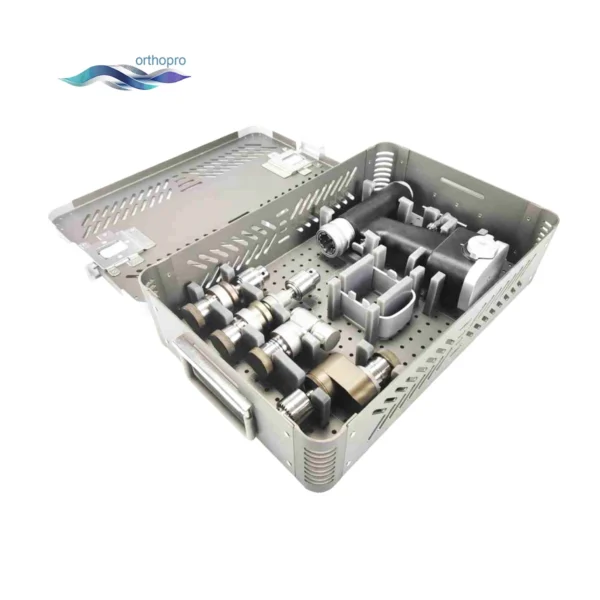
Multi-Functional Orthopedic Bone Drill System for Joint Surgery | OrthoPro
The OrthoPro Multi-Functional Orthopedic Bone Drill is a premium surgical power tool for precise bone drilling and cutting. This versatile orthopedic bone drill features a robust brushless motor. Ideal for B2B medical suppliers, our surgical bone drill ensures reliability in joint and trauma surgeries.
Brushed vs. Brushless Motors
Here’s my hot take: If you are sourcing equipment in 2026 and you approve the purchase of a power tool with a brushed motor, you are making a huge mistake.
Brushed motors rely on physical carbon brushes making contact with a commutator. They create friction. Friction creates heat. Heat destroys the motor over time. They also generate tiny amounts of carbon dust, which is a nightmare for internal hospital infection control, even inside a sealed casing.
You must insist on Brushless DC (BLDC) motors.
Yes, they cost a bit more upfront. But they don’t overheat during a 3-hour joint replacement, they are significantly quieter (reducing OR noise fatigue), and their lifespan is literally double or triple that of brushed motors. It’s a non-negotiable for serious hospital procurement.
Decoding “Multi-Functional”: The Attachments You Actually Need
A system is only as good as its attachments. When reviewing a quote, don’t just look at the handpiece. Look at the coupling mechanism. Is it proprietary, or does it accept standard AO or Hudson shanks? If it’s heavily proprietary, you are locked into their ecosystem forever, and they will gouge you on consumables.
Here is a breakdown of the standard attachments a decent multi-functional surgical bone drill should support, and what your surgeons use them for.
| Attachment Type | Primary Clinical Application | Key Procurement Consideration |
| Standard Jacobs Chuck | Basic drilling, generic bit holding | Must have a keyless option. Surgeons hate losing the chuck key mid-surgery. |
| Cannulated Drill Attachment | Trauma surgery, inserting guide wires | Check the cannulation diameter. It needs to fit standard K-wires (usually up to 4.0mm). |
| Sagittal / Oscillating Saw | Joint replacement, major bone cuts | Look for vibration reduction. High vibration causes surgeon hand fatigue. |
| Reamer Attachment | Intramedullary nailing, hip surgery | Must have a high-torque reduction gearbox. |
| Wire/Pin Driver | Trauma, external fixation | Needs a smooth trigger for precise, slow-speed insertion. |
Your surgeons might say they need all of these. In reality, look at your hospital’s case mix. If you are a level 1 trauma center, prioritize the cannulated drills and pin drivers. If you do 500 knee replacements a month, focus on the oscillating saw and reamer performance.
The Hidden Killer: Battery Chemistry and Autoclave Damage
This is where the majority of medical equipment sourcing goes wrong. Buyers negotiate a great price on the hardware, but completely ignore the batteries.
According to clinical engineering reports and independent biomedical tech surveys, battery failure accounts for roughly 40% to 50% of all power tool issues during live surgeries. Nothing causes a surgeon’s blood pressure to spike faster than a drill dying halfway through cutting a femur.
Here’s the brutal truth: Hospitals sterilize equipment using steam autoclaves at 134°C (273°F) with high pressure. Heat is the ultimate enemy of batteries.
Older systems use NiMH (Nickel-Metal Hydride) batteries because they are somewhat stable under heat. But they suffer from “memory effect” and lose their charge capacity quickly.
Modern systems use Lithium-Ion (Li-ion). Li-ion provides massive power, no memory effect, and a long shelf life. But you can’t just throw a raw Li-ion cell into an autoclave; it would explode.
Manufacturers have to build heavy-duty thermal shielding around the battery packs. When you evaluate a vendor, ask them specifically:
- Are the batteries fully autoclavable, or do we have to use aseptic transfer shields? (Aseptic transfer is a clunky process where a non-sterile battery is dropped into a sterile housing. It’s cheap, but OR nurses hate it).
- What is the guaranteed cycle life of the battery under standard hospital sterilization protocols?
If a vendor won’t guarantee at least 400 to 500 sterilization cycles before the battery degrades past 80% capacity, cross them off your list.
Real-World Case Study: Escaping the Single-Use Trap
I want to share an anonymous example from a mid-sized (roughly 300-bed) regional hospital we consulted with last year.
Their orthopedic department was a mess. They had five different surgical power tool systems from three different brands. One dedicated saw system for total joints, two lightweight drills for sports medicine, and a couple of heavy-duty reamers for trauma.
The sterile processing department (SPD) was constantly backed up. The nurses in the OR were constantly frustrated because the battery charger for the trauma drill was broken, and the chuck key for the sports med drill was missing. The “compatability” matrix for their blades and drill bits looked like a conspiracy theory whiteboard.
The procurement director finally put her foot down. She cleared out the old inventory and standardized the entire department on a high-quality multi-functional orthopedic bone drill system.
Instead of maintaining 15 different handpieces, they bought 6 multi-functional handpieces and a complete set of modular attachments (saws, reamers, wire drivers).
The results?
- OR Turnover time: Decreased by an average of 12 minutes per case, simply because the scrub techs weren’t hunting for specific brand-name batteries.
- Maintenance costs: Dropped by 40% in year one.
- Surgeon satisfaction: Actually went up. They loved the balanced weight of the new handpieces and the power of the brushless motors.
This is the ROI you need to present to your hospital board. It’s not just about the invoice price; it’s about operational efficiency.
Total Cost of Ownership: What the Rep Won’t Tell You
When you’re building out your orthopedic power tools buying guide, TCO is the only metric that matters. Sales reps love to discount the capital equipment (the drill itself) to get their foot in the door, because they know they will bleed you dry on service contracts and consumables.
Here is what you actually need to model out for a 5-year TCO projection:
- Initial Capital Outlay: Handpieces, attachments, sterilization cases, and battery chargers.
- Consumables: Saw blades, drill bits, K-wires. Crucial tip: Ensure the multi-functional drill uses open-standard consumables. If it only accepts proprietary blades that cost $90 each, your operational budget will explode within six months.
- Battery Replacement: Expect to replace all batteries at least once, maybe twice, in a 5-year window. Factor this in at day one.
- Preventative Maintenance (PM) and Repairs: Handpieces need their seals replaced and gearboxes lubricated. Check the vendor’s turnaround time for repairs. If they have to ship the drill overseas for a 6-week repair, you have to buy more backup units.
You need a partner, not just a vendor. You need a company that offers robust warranties, reasonable consumable pricing, and gear that actually survives the harsh hospital environment.
Why You Need to Look Beyond the “Big Three” Brands
Look, no one ever got fired for buying the biggest brand names in medical devices. But a lot of hospitals went broke doing it.
The technology behind a surgical bone drill is no longer a closely guarded secret. Advanced brushless motors, high-grade surgical stainless steel, and precision gearboxes are available globally. The difference now is overhead. The massive corporations have billions in overhead, huge marketing budgets, and massive sales commissions to pay out. Guess who pays for that? Your hospital.
This is why smart procurement teams are looking at specialized, agile manufacturers like OrthoPro. We focus exclusively on the engineering and durability of the tools, without the bloated markup.
Our systems are designed from the ground up for the realities of the modern OR. They feature true brushless technology, universally compatible chucks and blade mounts, and fully autoclavable battery systems that don’t quit after a few months. We understand that a hospital procurement manager needs reliable specs to defend their purchasing decisions, and that’s exactly what we deliver.
If you’re tired of fighting with massive vendors over repair costs and proprietary blades, it’s time to rethink your sourcing strategy.
FAQ: Hospital Procurement for Bone Drills
Q: Can we use third-party batteries in a brand-name multi-functional drill?
Honestly, it’s a massive risk. While they are cheaper, third-party batteries often void the manufacturer’s warranty on the handpiece. Worse, if a third-party battery fails or overheats during a procedure, the liability falls entirely on the hospital. It’s better to source a complete system from a high-value provider where the OEM batteries are reasonably priced from the start.
Q: What IP rating should a surgical power tool have?
You should be looking for IPX6 to IPX8 ratings. IPX8 means the equipment is protected against continuous submersion in water. Since these tools are going to be scrubbed, soaked in enzymatic cleaners, and blasted in an autoclave, superior moisture sealing is critical to prevent internal corrosion of the electronics.
Q: How often do these drills need to be calibrated or serviced?
Most high-quality brushless systems require preventative maintanence once a year, or after about 300 autoclave cycles. This involves replacing the internal O-rings, checking the motor alignment, and verifying torque output. Make sure your supplier offers a clear, fast-turnaround maintenance program.
Q: Are pneumatic (air-driven) systems better than battery-powered ones?
Twenty years ago, yes. Today, absolutely not. Pneumatic hoses clutter the sterile field, create a tripping hazard, and drag down the surgeon’s hand. Battery technology has advanced so much that modern cordless drills match or exceed the torque of old air-driven systems. Cordless is the future, hands down.
Take Control of Your OR Budget
Navigating hospital procurement doesn’t have to be a constant battle between clinical needs and budget caps. By standardizing on a high-quality, non-proprietary multi-functional system, you can reduce OR turnover times, slash your sterilization backlog, and cut your consumable spend significantly.
Don’t let aggressive sales reps push you into proprietary ecosystems. Demand transparency on battery life, torque outputs, and repair costs.
If you are currently evaluating your orthopedic equipment needs and want a real, BS-free assessment of how much you could save by switching to a reliable alternative, let’s talk.
You can check out the full technical specs of our flagshipMulti-Functional Orthopedic Bone Drill here.
Stop overpaying for logos and start investing in performance. Contact the OrthoPro team today or shoot us an email directly at info@orthopro.mx. We can provide you with a detailed TCO analysis and bulk pricing quotes tailored perfectly to your hospital’s specific case volume.