
We’ve all sat in those exhausting Q3 budget review meetings. The Chief of Neurosurgery is pounding the table for the latest, shiniest surgical toys, and you—the CFO or Head of Procurement—are staring at a spreadsheet that’s already bleeding red. The tension between clinical wants and financial reality is brutal.
I’ve looked at hundreds of hospital purchasing sheets, and I see the exact same mistake happening everywhere. Clinics try to save a quick buck on the initial purchase price of surgical power tools, completely ignoring what happens in years two, three, and four.
Let’s get one thing straight right off the bat: buying budget equipment for a neurosurgery department isn’t just a headache, it’s actual financial negligence. When we talk about neurosurgical equipment costs, the sticker price on the invoice is just the tip of a very expensive iceberg. The real money—the stuff that either saves your annual budget or gets you fired—is hidden in the lifecycle costs.
Today, we are going to strip away the marketing fluff and look at the hard numbers. We’ll break down how to actually calculate medical device ROI, why battery chemistry matters to your bottom line, and why upgrading to a premium self-stopping craniotomy drill is probably the smartest financial move your clinic can make this year.
The “Iceberg Illusion” of Neurosurgical Equipment Costs
Most purchasing departments operate on a fatal flaw: they treat CapEx (Capital Expenditure) and OpEx (Operational Expenditure) as entirely seperate worlds. So, you pat yourself on the back for scoring a cheap cranial drill and saving $4,000 on the CapEx budget. Great job, right?
Wrong.
The moment that budget drill hits the operating room, the OpEx meter starts running at blinding speed. You see, cheap drills aren’t cheap because the manufacturer felt generous. They are cheap because they use inferior gearboxes, poorly sealed motors that degrade quickly in the autoclave, and sub-par lithium or NiMH cells.
Let’s look at the hidden costs that sink your budget:
- Operating Room Downtime: Various industry studies peg the cost of OR time at anywhere from $36 to over $100 per minute. If a cheap drill stalls or the battery dies mid-procedure, and the surgical tech has to scramble for 8 minutes to find a backup, you just lost up to $800. If that happens ten times a year, you’ve already wiped out your initial “savings.”
- The Sterilization Tax: Every time a drill goes into an autoclave, it faces high-pressure steam and extreme heat. Budget drills have terrible moisture seals. The internal components corrode, leading to frequent repairs.
- Liability and Complications: We’ll dive into the self-stopping feature soon, but a manual drill in the hands of a fatigued surgeon can lead to dural tears. Complication management is the fastest way to drain hospital profitability.
If you want to manage neurosurgical equipment costs, you have to look at the Total Cost of Ownership (TCO) over a 5 to 7-year horizon. Anything less is just pretending to do your job.
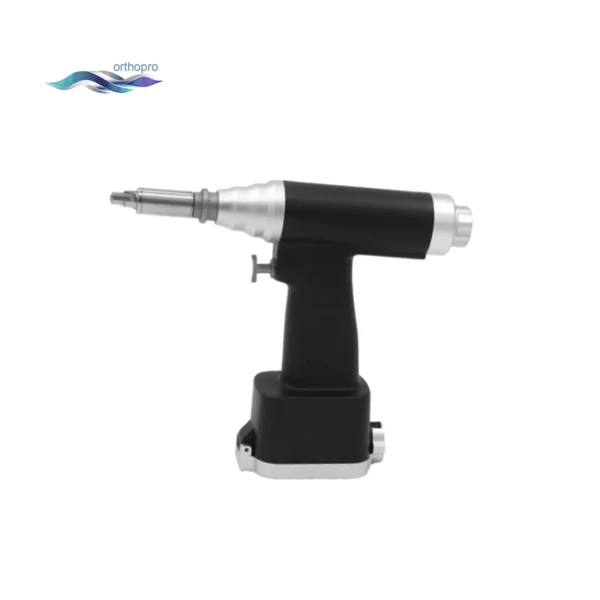
Self-stopping Craniotomy Drill for Neurosurgery | Precision Skull Power Tool for Hospitals & B2B Suppliers
The OrthoPro self-stopping craniotomy drill is an essential neurosurgical power tool designed for safe and efficient skull penetration. This high-precision self-stopping craniotomy drill features an automatic stop mechanism to protect the dura mater. Engineered for neurosurgery, our cranial drill offers variable speed and full autoclavability for superior hospital performance.
Breaking Down Medical Device ROI (The Real Math)
A lot of folks throw around the term ROI without actually doing the math. They think ROI just means “we use it alot so it’s worth it.” That’s not how finance works.
To figure out your true medical device ROI, you need to use a solid, comprehensive formula. Forget the fancy accounting software for a second, here is the plain text math you should be running on the back of your napkin:
Medical Device ROI (%) =[ (Total Financial Benefits – Total Cost of Ownership) / Total Cost of Ownership ] * 100
But what goes into those buckets?
- Total Financial Benefits: This isn’t just revenue from surgeries. It includes cost avoidance. If a premium drill shaves 15 minutes off a craniotomy because of better torque and the self-stopping feature, calculate 15 mins * $60/min * 100 surgeries a year = $90,000 in saved OR time annually.
- Total Cost of Ownership (TCO): This includes the Initial Purchase Price + Annual Maintanence Contracts + Cost of Replacement Batteries + Cost of Sterilization Processing + Estimated Repair Downtime Costs.
When you run this formula, you quickly realize that a premium tool with a higher upfront cost but near-zero mid-surgery failures delivers an ROI that absolutely crushes budget alternatives.
Surgical Drill Battery Life: The Silent Budget Killer
Let’s talk about the most frustrating part of any power tool: the batteries.
I can’t tell you how many procurement managers ignore surgical drill battery life when signing contracts. They assume all batteries are created equal. This is a massive mistake.
In a high-volume neurology clinic, drills are used and recharged constantly. Cheaper drills often use outdated battery chemistry or poor battery management systems (BMS). What does that mean for you?
- Memory Effect & Degradation: Cheap batteries lose their maximum charge capacity after just 100 to 150 autoclave cycles. Suddenly, your surgeons are complaining that the drill dies halfway through cutting a bone flap.
- The Replacement Treadmill: If a battery pack costs $800, and you have to replace three packs per drill every 18 months because they won’t hold a charge, your TCO is skyrocketing.
- Workflow Paralysis: When scrub nurses don’t trust the battery indicator, they start opening multiple sterile battery packs “just in case.” You are now paying sterilization costs for equipment that wasn’t even used.
Premium systems, like those offered by OrthoPro, utilize advanced, high-density power cells housed in heavily shielded, thermally protected casings. They are engineered to survive the brutal environment of hospital autoclaves while maintaining peak voltage output. Yes, they cost more upfront. But they actually last. If you aren’t factoring battery replacement cycles into your purchasing matrix, you are flying blind.
Cranial Drill Lifespan: The Ultimate CapEx Differentiator
How long should a drill last? If you ask a budget manufacturer, they’ll mumble something about a 1-year warranty and offer you an overpriced extended service plan.
A premium cranial drill lifespan should comfortably hit 5 to 7 years, even in a busy trauma center.
The difference in lifespan comes down to micro-engineering. Craniotomy drills spin at incredibly high RPMs (often upwards of 60,000 RPM for high-speed attachments, though craniotomes operate differently). At those speeds, even a microscopic misalignment in the bearings causes vibration. Vibration creates heat. Heat destroys motors.
Budget drills use standard off-the-shelf bearings. Premium drills use custom-machined, aerospace-grade components.
Let’s look at a 5-Year Lifecycle Comparison:
| Cost Category | Budget Craniotomy Drill | Premium OrthoPro Drill |
| Initial Purchase Price | $8,000 | $14,000 |
| Battery Replacements (5 yrs) | $4,800 (6 units) | $1,600 (2 units) |
| Out-of-warranty Repairs | $3,500 | $800 |
| Lost OR Time due to failure | $12,000 (est. conservative) | $0 – $1,000 |
| Total 5-Year Cost | $28,300 | $17,400 |
The numbers don’t lie. Over five years, the “expensive” drill is actually ten grand cheaper. And that’s before we even talk about the clinical features that actively prevent lawsuits.
The Financial Impact of “Self-Stopping” Tech
This is where clinical features cross directly over into financial risk management.
A self-stopping craniotomy drill (also known as a cranial perforator) is designed with a mechanical clutch. As the surgeon drills through the skull, the device relies on the resistance of the hard bone. The exact millisecond the drill bit breaches the inner table of the skull and hits the soft dura mater, the loss of resistance triggers the clutch. The drill bit instantly stops spinning, even if the surgeon’s finger is still pulling the trigger.
Why should a CFO care about a clutch mechanism?
Because dural tears are a financial nightmare.
If a surgeon using a standard, non-stopping drill accidentally plunges too deep, they tear the dura.
- Immediate cost: The surgeon now has to repair the tear. This adds an average of 30 to 45 minutes to the surgery time. At $60/minute, you just lost $2,700 on OR time alone.
- Secondary cost: The patient is now at high risk for a Cerebrospinal Fluid (CSF) leak or meningitis. Their ICU stay is extended. In many healthcare systems, complications mean the hospital eats the cost of the extended stay—insurance won’t reimburse for hospital-acquired complications.
- Tertiary cost: Malpractice litigation. The legal fees alone can eclipse the entire annual budget of your department.
By investing in a Self-Stopping Craniotomy Drill, you are effectively buying an insurance policy against one of the most common and costly surgical errors in neurosurgery. It’s a risk mitigation tool that pays for itself the very first time the clutch engages.
A Real-World Case Study (Or: How Not to Run Procurement)
I want to share a story about a mid-sized private hospital group down in Latin America. We’ll keep them anonymous to spare the procurement director’s pride.
Three years ago, they were expanding their neuro-trauma wing. The CFO mandated a strict 15% cut on all CapEx requests. The procurement team, desperate to hit the target, scrapped the premium equipment list and bought a fleet of budget cranial drills from a no-name supplier. They hit their CapEx goals and got their end-of-year bonuses.
By Month 14, the nightmare started.
First, the surgical drill battery life tanked. Surgeons were going through three batteries for a single trauma case. Then, the poorly sealed motors started seizing up mid-operation because moisture from the autoclaves had rusted the internal gearboxes.
The breaking point came during an emergency hematoma evacuation. The budget drill stalled completely. The surgical team lost 12 critical minutes waiting for a manual hand-crank drill to be sterilized and brought in. The patient survived, but the surgeon marched straight into the hospital director’s office and threatened to resign.
That hospital had to throw away $40,000 worth of budget equipment—which was now essentially toxic plastic—and rush-order premium replacements at a massive markup because they had zero leverage.
They eventually switched to OrthoPro’s surgical solutions, but the damage to their balance sheet (and their reputation) was already done. The lesson? You can’t outsmart bad equipment. It will always collect its debt in the end.
A Controversial Take on Hospital Buying
I’m gonna say something that usually gets me angry emails from hospital administrators: Stop treating your surgeons like they don’t know the value of money, but also stop letting your procurement teams buy the absolute cheapest crap they can find on Alibaba.
There is a toxic culture in hospital finance where the goal is simply to win the negotiation on the purchase price. Procurement thinks they are saving the hospital. But surgeons know that when they are standing over an open skull at 3 AM, the purchase price means absolutely nothing. Reliability is the only currency that matters.
When you align clinical needs (reliability, precision, self-stopping safety) with financial realities (long-term cranial drill lifespan, low maintanence, high ROI), everyone wins. It requires a mindset shift from “cost-cutting” to “value-investing.”
Bottom Line: It’s Time to Upgrade
Stop throwing good money after bad. If your clinic is constantly paying for power tool repairs, suffering through battery failures, or dealing with OR delays, your current equipment is financially bleeding you dry.
Upgrading to premium neurosurgical tools isn’t a luxury; it’s a calculated financial strategy to protect your hospital’s profit margins and your patients’ lives. The math heavily favors quality.
If you are ready to stop playing games with your surgical budget and want to see how premium equipment can transform your OR efficiency, you need to talk to the experts. Head over to the OrthoPro website to explore their full range of medical devices.
Don’t wait for a mid-surgery equipment failure to force your hand. Be proactive. You can contact our team directly or shoot an email to info@orthopro.mx for a customized ROI analysis tailored specifically to your clinic’s surgical volume. Let’s get your OR running the way it’s supposed to.
FAQ: Making the Right Financial Call on Neurosurgical Equipment
Q1: How do I accurately calculate depreciation for neurosurgical power tools?
Most hospitals use straight-line depreciation over a standard 5-year useful life for medical devices. However, this is where cranial drill lifespan becomes a massive factor. If you buy a premium drill that actively lasts 7 years, you are gaining two years of “free” operational use after the asset has been fully depreciated on the books. This artificially boosts your department’s profitability in those twilight years. Always ask vendors for independent data on average device lifespans before locking in your depreciation schedules.
Q2: Why does surgical drill battery life degrade so much faster on cheaper models?
It all comes down to cell chemistry and thermal management. Operating rooms require batteries to be sterilized via autoclaving—meaning they get blasted with high-pressure steam at 134°C (273°F). Cheap batteries lack adequate thermal shielding. The heat bakes the lithium-ion cells, fundamentally altering their internal chemistry and drastically reducing their ability to hold a charge. Premium brands invest heavily in proprietary thermal encapsulation, which protects the cells and extends the battery’s usable life by hundreds of cycles.
Q3: Is the self-stopping feature really worth the premium markup?
Without a doubt. Think of it as a one-time insurance premium. A manual drill relies entirely on the surgeon’s tactile feedback to know when they’ve breached the bone. Even the best surgeons experience fatigue. A single dural tear can cost a hospital tens of thousands of dollars in extended OR time, ICU stays, and potential litigation. A self-stopping drill mechanically prevents this specific complication. When you factor in the cost avoidance of just one averted complication, the feature easily pays for the entire drill. It’s the highest driver of medical device ROI in the neurosurgical toolkit.